Showing posts with label environmental news. Show all posts

Friday, 8 December 2023

Thoughts and Opinions: Canada's Ban on Single-Use Plastics Overturned

In November of this year, Canada's ban on single-use plastics was overturned by the Federal court. The original ban was described as "unreasonable and unconstitutional", and the decision voiced that all plastics cannot be listed as toxic.

Although this move will result in losses for the environment, I am not quick to deem this an overall failure. As a front-line retail worker with a regular retail company that sells reusable bags, I have personally seen a difference in peoples' shopping habits, namely as it pertains to bringing reusable shopping bags. It also did give some businesses the catalyst to start offering reusable or paper shopping bags, which they may very well continue even though the ban has been overturned.

And from the perspective of an everyday person, what the the ban did not seem to accomplish in its time was marked effort on the part of consumers as a whole to bring their own reusable straws, cups, and other utensils. The 10 cents off that a customer might get at a cafe is not enough financial incentive to carry around a reusable cup all day.

(It also didn't stop some independent shops from simply continuing to offer single-use plastic bags, or some big-box stores from offering cheaply-made "reusable" bags that broke by the time you got home.)

Rather, the primary motivation must be more intrinsic, which requires more of a mental and cultural shift.

As a child, one of the most rewarding things I did in school during the early 2000s was organize a SIGG reusable water bottle sale with the school's Green Club, supervised by our lovable librarian who I have so much to thank for.

I cringe a little now when I think back to my choice of words, but I remember spouting in our executive meeting how "we have to make going green hip!" 

But "hip" it was.

The reusable bottles had a variety of creative designs printed on them, some more plain others more bold, but all objects of excitement and hope. And as reusable bottles have become the norm more and more for students and adults in the workplace, it has proved to be more than a trend.

And even though the water bottle movement is far from solving the world's environmental crisis, it is heartwarming to see what we accomplished even as children.

Partly because of this experience, I do believe the merging of art, environmentalism, and even play is more powerful than the sum of its parts. Without legislation and without financial incentive, a few hundred individuals -children, teachers, parents- set a standard for ourselves to live by. 

And although this was not explicitly play, I do believe it also illustrates the power of making environmentalism fun. Whether it was children turning the fundraising campaign into a game, or teachers smirking over the "make love not landfill" staff-only edition, it is my hope and deep down my belief that most people who were involved look back on this as something that was both fun and meaningful to be a part of. Having positive volunteer experiences like this can also leave a deep imprint on a child and translate to a positive effects on wellbeing.

So now looking at where we are, facing the overturn of Canada's ban on single-use plastics, it may not necessarily be as much of the loss for the environment as it might feel.

We may be left without the legislation pushing the unwilling closer to the line of sustainability, but we still have the open minds of those who are willing if they are only given the chance, the event, the catalyst to start.

Photo added 2023-12-09

Thursday, 12 January 2023

January 2023 Study's Prediction on Global Glacier Change in the Next One Hundred Years (also, icebreaking NN's haitus)

After an extended hiatus, thank you to everyone who is still here and welcome back to Nature Nimbus. 

To break the ice, let's start with sharing a bit of research on a new study on the fate of the world's glaciers.

Global Glacier Change in the Next One Hundred Years

A study published on January 5th of this year in the journal Science estimates that there will be substantially more loss of glaciers in the next century than predicted by previous models. David R. Rounce and his team predict that this figure may look like one quarter to one half of glacier masses on the planet may melt within the next 100 years.

Chris Mooney of the Washington post writes:

"The study, published Thursday in the journal Science, finds that even with just 1.5 degrees Celsius (2.7 degrees Fahrenheit) of warming above preindustrial levels, some 104,000 of the world’s more than 215,000 mountain glaciers and ice caps will melt, raising global sea levels by a little shy of 4 inches." (Mooney, 2023)

As many people already know, glaciers are giant, ancient masses of ice. Their melt provides water, and they are so massive that whether they stay frozen or they melt significant impacts sea levels, and has implications for availability of drinking water.

The term "pre-industrial climate" could technically refer to any point in time before the industrial revolution. Left undefined, this can make for a bit of a difficult point of reference to work with because measurements of temperature available before the industrial revolution are limited. However, a study may choose to declare a more specific time range, such as an IPCC Special Report on Global Warming of 1.5°C using 1850–1900 as a point of reference pre-industrial temperature explaining,"[1850-1900] is the earliest period with near-global observations and is the reference period used as an approximation of pre-industrial temperatures in the IPCC Fifth Assessment Report" (IPCC, n.d.).

Further, "1.5 degrees Celsius of warming" refers to the total average temperature around the whole world, not in one smaller, more local place. This is why in spite of global warming, there can still be very intense winter storms with changing climate. Some places are warming faster than others. Predicting what effects this could have on local weather events for example can be very difficult, though many people around the world have experienced a change in climate and lived through more severe weather events than expected.

The COP21 Paris agreement in 2015 had made the goal of preventing 1.5 degrees Celsius of warming globally, though if temperatures continue to rise at the rate that they currently are, this goal will not be met (IPCC, n.d.).

A Recent Student's Perspective

Something that struck me as a student in an environmental program was the emphasis on climate resilience. I had expected much more emphasis on combating climate change itself, but instead the message I found was that one of the most critical ways civil engineers and technicians can help is to design and build infrastructure in a way helps communities accommodates expected changes in climate.

While this message could received as resignation, a more fruitful approach may be to see it as adaptation. Although it is too late to change our past choices, there is still much good that can be done when we are resolved to do the best we can to manage the cards still in our hand.

Sources

IPCC. (n.d.). FAQ Chapter 1. Global Warming of 1.5 ÂșC. Retrieved January 11, 2023, from 

https://www.ipcc.ch/sr15/faq/faq-chapter-1/ 

Mooney, C. (2023, January 8). Half of Earth's glaciers could melt even if key warming goal is met, 

study says. The Washington Post. Retrieved January 11, 2023, from https://www.washingtonpost.com/climate-environment/2023/01/05/glaciers-melt-this-century-warming/ 

Thursday, 22 April 2021

Earth Day 2021: Taking a Walk In the PaRx

Happy Earth Day. If you have been following ecotherapy posts, this one is especially for you.

As of March 2021, the Park Prescriptions Program was launched in Ontario. This enables doctors to give a "PaRx" medical prescription of spending time in nature (Martinko, 2021). 

Why this can be so beneficial it is no mystery to many people throughout the world, across many cultures and varieties of physical environments. The mental and emotional benefits of greenspace and bluespace on people in urban workplaces has been studied, as well as the emotional impacts of low vitamin D and not getting enough sun. 'Forest Bathing' has also been discussed across continents, and the developmental benefits of free play in nature was examined in depth by Richard Louv in his book, Last Child In the Woods.

Louv is also the man who coined the term 'nature deficit disorder'. Unfortunately I don't have a copy of the book anymore, but it might have been in the foreword where he wrote about how he didn't come up with that term intending to add to medical jargon. However, now in the midst of the pandemic it is possible that this descriptive term might resonate with more people than ever.

And for some, maybe especially during Earth Month.

Surprising to many, Seasonal Affective Disorder (SAD) tends to be at its worst starting in the spring. While winter blues is real, seasonal depression takes a new swing in April of each year (CMHA).

This year, there is also a pandemic to deal with that has come with grief for many, and that has stretched on much longer than some us might have anticipated. The third wave that loomed over Ontario for a little while arrived with rain and earlier sunsets and collective complaints of bad sleep; this increase of insomnia over the pandemic in Canada as well as other countries such as China has been dubbed "coronasomnia" (Lufkin, 2021).

Original source unknown. Different versions of this meme
are being reposted all over social media.

There may be many factors driving this, but less time outside may very well be amoung them. Sunlight is known to play a key role in maintaining the body's healthy circadian rhythm, while exposure to artificial lights can be disruptive to this. Experiments from University of Rochester found a nearly 40% increase in vitality of participants spending time outside in green, natural environments. (Heid, 2016).

Referenced Times writer Mark Heid also highlighted this point from Richard Ryans, a psychology professor from University of Rochester: "While more is better, just 20 minutes a day spent in green spaces has an “enhancing effect” on vitality, Ryans says, as long as you leave your smartphone behind. If that’s not possible, packing your place with plants or just looking at photos of nature can chill you out, he says."

And with numbers to sketch out the details or not, many would wholeheartedly attest to the positive associations between lowered feelings of stress, and more good feelings when spending time in nature.

There is also information on park prescriptions available for patients and doctors alike, including on parkprescriptions.ca/prescribers. This page includes explanation on why writing out a PaRx is particularly beneficial to patients. It also touches on how people connecting with nature also benefits the environment as a whole, which extends out including the natural environment and communities (Mackay, 2019). 

This year has been hard on so many people, but time in nature has most certainly softened the blow. In parks and on trails, and while drinking a bit of sun next to plants on windowsils. Some words people have used to describe how they feel in nature include invigorated, peaceful, creative, happier, kinder.

Earth Day is in a sense, a reminder for us to be kind. This Earth Day and every day, may we be kind, and find happiness in the little things.

Sources

CMHA. (n.d.). Seasonal Affective Disorder. Retrieved April 22, 2021, from https://cmha.bc.ca/documents/seasonal-affective-disorder-2/

Heid, M. (2016, April 27). You Asked: Is It Bad to Be Inside All Day? Retrieved April, 2021, from https://time.com/4306455/stress-relief-nature/

Mackay, C. M., & Schmitt, M. T. (2019). Do people who feel connected to nature do more to protect it? A meta-analysis. Journal of Environmental Psychology, 65, 101323. doi:10.1016/j.jenvp.2019.101323

Martinko, K. (2021, March 10). Ontario Doctors Can Now Prescribe Time in Nature to Patients. Retrieved March, 2021, from https://www.treehugger.com/ontario-doctors-prescribe-time-nature-patients-5115293#:~:text=Two hours a week, 20,from time spent in nature

Lufkin, B. (2021, January 25). The 'coronasomnia' phenomenon keeping you from getting sleep. Retrieved from https://www.bbc.com/worklife/article/20210121-the-coronasomnia-phenomenon-keeping-us-from-getting-sleep

Visit parkprescriptions.ca/whynature for more information on Canada's PaRx program, and how it helps.

Sunday, 1 March 2020

Terms to Know Regarding the Wet'suwet'en Stand Against the Coastal GasLink Rout

There has been lots of news coverage on the Wet'suwet'en peoples' stand against the Coastal GasLink pipeline, and lots of information to get through. As is often the case I didn't understand what was going on just from the first article I saw about it (or second, or third...), but a member of a Facebook group with family in the middle of it all kindly shared lots of resources to help me out.

While I was going through articles, I came across a lot of different terms and names, and decided to scrap a summary of the news itself in favour of a vocab and people list instead:

TC Energy (formerly TransCanada) - The company making the pipeline.

LNG Canada - the people who selected TC Energy to fulfill the Coastal GasLink natural gas pipeline.

Royal Dutch Shell plc - the people who own LNG Canada

Wet’suwet’en Nation - the 22,000 square km of unceded traditional territory held by the Wet'suwet'en since pre-colonial times.

The Wet’suwet’en First Nation - the 700-member reserve band village (thanks Merv Ritchie who commented on the referenced thetyee.ca article)

Unist'ot'en - One of five Wet’suwet’en clans. Years ago they established a gated camp along the planned pipeline rout.

"The 22,000 square km of Wet’suwet’en Territory is divided into 5 clans and 13 house groups. Each clan within the Wet’suwet’en Nation has full jurisdiction under their law to control access to their territory" - http://unistoten.camp/about/governance-structure/.

Elected chiefs - Elected chiefs also serve the community in an authoritative role, however their powers only extend as set out in the Indian Act (1876) by colonial federal government, including jurisdiction over reserves.

Band councils - Like elected chiefs, the role of elected band council was created under the Indian Act (enacted in 1876) by colonial federal government.

Hereditary chiefs (sometimes called house chiefs) -  the responsibility of hereditary chief is a position held according to traditional Wet'suwet'en governance. The jurisdiction of hereditary chiefs vary between groups, however hereditary chiefs are the Title Holders of the Wet'suwet'en land. (For more details: affirmation in 1997 by the Supreme Court of Canada, in the decision of Delgamuukw v. British Columbia).

unceded land - land where powers over it has not been legally handed over to colonial government.

Reconciliation - “. . . Reconciliation is about establishing and maintaining a mutually respectful relationship between Aboriginal and non-Aboriginal peoples in this country. In order for that to happen, there has to be awareness of the past, an acknowledgement of the harm that has been inflicted, atonement for the causes, and action to change behaviour.” - The Truth and Reconciliation Committee (https://www.ictinc.ca/blog/what-reconciliation-is-and-what-it-is-not)

United Nations Rights of Indigenous Peoples (UNDRIP) - passed into British Columbia provincial law in November 2019. "UNDRIP clarifies the rights of Indigenous Peoples to Free, Prior, and Informed Consent regarding projects that impact their lands and livelihoods. It also clarifies that Indigenous Peoples will not be forcefully removed from their lands." - https://canadians.org/analysis/five-things-you-should-know-about-wetsuwetens-fight-their-rights

     While there was a lot of "what's happenings" to read about, it took a while to sift through to understand why or just how this conflict came about.
      A key point that I did not initially understand is that consultation with 20 First Nations did actually take place, and representatives from all 20 signed in agreement with the rout. However, the actual title holders to the Wet'suwet'en land did not sign. All five hereditary Wet'suwet'en chiefs -the title holders of part of the land that they are planning to put the pipeline on- are unanimously opposed.

References
https://thetyee.ca/Analysis/2019/01/08/LNG-Pipeline-Unistoten-Blockade/
http://unistoten.com/
https://vancouversun.com/news/local-news/open-letter-to-wetsuweten-hereditary-chiefs-after-tsayu-clan-meeting
https://www.coastalgaslink.com/about/approved-route/
https://www.greenpeace.org/canada/en/story/28856/what-you-might-not-know-about-indigenous-law-and-the-raids-on-wetsuweten/
https://www.jwnenergy.com/article/2019/12/correction-coastal-gaslink-pipeline-series/
https://www.tcenergy.com/Static/images/pipeline/pdf/TransCanada-protecting-the-land.pdf

Written 2020-02-29

Monday, 25 February 2019

Snowfall In Hawaii at Possibly the Lowest Elevation Yet

Historic news has come with a winter storm, as Hawaii State Park is has been hit with snowfall for the first time in recorded history.

It is normal for snow to be seen at the tops of Mauna Kea and Mauna Loa which peak at altitudes of summit elevations of 4207m and 4169m respectively, not a mere 1890m, which is about the elevation of Polipoli which has experienced snow.

According to USA today, Chip Fletcher, an earth sciences prof at University of Hawaii, has said "there's no place on the planet where (people) can expect to see conditions as they have seen in the past." Fletcher is also the vice chair of the Honolulu Climate Change Commission.

Hawaii is a dream vacation spot for many especially as a winter getaway, and it is possible that snowfall has not been seen at this elevation before in Hawaii.

Resources:
https://twentytwowords.com/snow-fallen-hawaii-state-park-first-time-ever/
https://www.usatoday.com/story/news/2019/02/11/hawaii-extreme-weather-example-climate-change-experts/2843281002/
https://www.dangerousroads.org/north-america/usa/3818-mauna-kea-access-road.html
http://www.newworldencyclopedia.org/entry/Mauna_Loa
http://time.com/5528417/hawaii-snow-storm-polipoli-state-park/

Monday, 20 August 2018

History in the Storeys of Sediments in an Ontario Lake

Hi guys, hope everything is having a great summer in the northern hemisphere/winter if you are in the south.

Just wanted to share some local news from Ontario on the research side of things, as the Weather Network reported that a team of researchers believes they may have found a treasure trove of environmental history at the bottom of a lake, which happens to be right here in Ontario!

What they're looking for is a way to examine what might have been a turning point due to human activity, changing the way our planet operates on a significant level.

Francine McCarthy, who is leading the research team, explained that Crawford Lake is an ideal place to be taking samples because nothing lives as the bottom, as the lake is 22 meters deep and anoxic, (anoxic meaning there is little to no oxygen).

If you have ever explored the Niagara escarpment, chances are the stones rocked your world. These are not only parts of the habitat beautiful to the eye, but over time they also can tell a story. McCarthy explained that over summers, pieces from the rocks bordering the escarpment will sink to the bottom. This creates layers of information-containing organic matter that can be analyzed like the rings of a tree.

The goal is to get some insight on just how much human activities have affected the environment, as these layers can help tell the story of what has happened globally through those years.

Specific information they are looking for includes amounts of materials related to human activities such as plutonium and microplastics. These can serve as something measurable to help with defining the start of the anthropocene, marking when humans really did take over the planet.

Source:
https://www.theweathernetwork.com/news/articles/team-of-researchers-from-ontario-believe-a-turning-point-in-earths-history-is-sitting-in-a-lake-in-milton-brock-carleton-mcmaster-university-sediment-crawford-lake/109666

Wednesday, 17 April 2013

New Ideas for Renewables: Storing Energy


    There is good news and some more good news this past week for advances in renewable energy. First, a team of researchers from North America reported that they have found a way to store unused, surplus energy from renewable resources like wind turbines and solar panels. A report by Chemists from Calgary University says that they have found a way to convert electrical energy into chemical energy by means of a new catalyst. This is important because although electrical energy “cannot simply be stored”, chemical energy can, which means that this new catalyst could fill the great need for an efficient method of storing excess clean energy for when it is needed when sources have lower intake, such as slower winds or less sunlight for wind or solar power.
    Second, two members of the team, Curtis Berlinguette and Simon Trudel, have thought up another way to utilize reconverted water in fuel cells with a process that would involve no pollutants, and possibly no water loss. If the hydrogen and oxygen results from split water molecules are stored separately then reconverted into water whenever it is needed, it could result in large amounts of energy to be converted to electricity. The difficulty so far is that the conventional catalysis in the process depends on crystalline minerals that are toxic, expensive, and rare. Still, this obstacle may be overcome, as the team also said they have had a successful reaction with a new equally-useful, safer, and cheaper electro-catalyst.
    After learning more details on different renewable resources, it is especially encouraging to hear about progress and interesting to take a deeper look into the possibilities of cleaner energy. To start, being able to store energy from renewable resources would be an amazing achievement, especially considering how much it is needed. The article went into the more technical side of energy, and it helps to realize and appreciate the complexity of it all. One of the drawbacks of renewable energy sources like wind and solar power is that is amount of energy produced isn’t always constant. Depending on weather conditions (specifically wind speed and amount of sunlight), sometimes energy demands are not met and so we turn back to non-renewable sources like fossil fuels. But if extra energy could be stored, it could be applied to compensate for days when less energy is produced. News of advancements being made by people who are really trying to find more environmentally-conscious options adds to a sense of motivation to keep working towards goals like these that really do make a difference. I wonder how far technology like this can be applied, from replacing a lot of fossil fuels with renewable energy to maybe even opening up other possibilities for other renewable sources.

Sources
Radford, T. (n.d.). Renewables burn a little brighter | Climate News Network.Climate News Network.

Wednesday, 3 April 2013

Blue Alert: Walking on Thin Ice


In 2012 the record-loss of sea ice has raised the debate over whether it was an anomaly, or the beginning of a disastrous trend. What is certain is that current reforming ice will be the thinnest on record, meaning much less summer ice, and some are predicting that summer sea ice could be almost completely gone by the year 2016. Concern is being backed up ‘blue alert’ satellite images of disappearing sea ice, a testament to the fact that melting sea ice may be an even bigger environmental concern for 2013 than warming itself. Concerns about water levels are being raised again, however, the IPCC (Intergovernmental Panel on Climate Change) has not been able to predict if the climate in some specific regions will ultimately be wetter or drier, making it more difficult for politicians at the Doha climate talks to discuss ways to adapt to the ‘unstoppable’ minimum 2 °C rise. These is specific uncertainty in the northern hemisphere, as 2012 data showed a slowing of the jet stream resulting in extreme weather conditions including a heatwave in Russia, cold spells in Europe, and drought in America.
This reminded me of something that read,“What we do on land [and in the air] is reflected in the water”. We are conscious that the condition of our atmosphere is going from bad to worse, but the ‘blue alert’ and disappearing sea ice is a shocking gauge at how far we have really gone. Hearing more news about the worsening condition of our environment from the atmosphere to the way that it is affecting everything else in nature —even the weather—  is shocking. So much life on Earth will be affected by drastic changes in weather. Increased awareness has proven to lead to positive change in our thinking and attitudes, and all the time there is more news saying similar things about the increasing danger the environment is in, and although we’ve already caused a lot of damage, we can still make changes today to start improving.

Sources
Pearce, F. (2013, January 2). 2013 Smart Guide: Arctic melt will spark weird weather - environment -
02 January 2013 - New Scientist. New Scientist. Retrieved April 3, 2013, from http://www.newscientist.com/article/mg21628965.300-2013-smart-guide-arctic-melt-will-spark-weird-weather.html

Monday, 1 April 2013

The Air of Mice and Men


A study published in Environmental Health Perspectives showed that baby mice exposed to concentrated, real urban air particles were more impulsive later than ones that were not. The mice were trained that to receive a sugary reward they could either press a lever 25 times, or wait for one to be released (called "delay discounting"). However, the releasing  interval were irregular and if a mouse pressed the lever, the waiting time would be reset. The ones that breathed in the pollution particles at four-days-old reset the system up to 43% more times by pressing the lever instead of patiently waiting. This number exhibits how those exposed to urban air pollution in the developing stages of life show more impulsive behaviour for self-gratification, and less patience as adults than ones not exposed to the tiny pollution particles. Such impulsive behaviour has been linked with cognitive and behavioral disorders such as ADHD and substance abuse, strongly suggesting a link between exposure to pollution during the developing stages of the brain and behavioural effects later on in life. Other dangers of ultrafine pollution particles from sources such as cars and factory production include damage to the lungs, heart, and brain, which are being made more evident through studies like this.
Polluted air is bad for not only lungs, but also the minds of people and other animals all sharing the same air and must suffer because of mankind's mistakes. The article did not mention other health effects these poor mice experienced from breathing in man-made pollutants, though asthma was included in damage to the lungs and I wonder if that affected them too. I believe that it is no coincidence that while society advances in technology, sometimes leaving appreciation for nature behind, psychological disorders are becoming more of a problem.
This report brings back the statistic that in one year, 100% of Ontario university graduates in therapy found a job within six months of graduating, displaying the great need for mental health professionals. 
In his book Last Child in the Woods, Richard Louv writes, “Reducing the [nature] deficit...is in our self interest, not only because aesthetics or justice demands it, but also because our mental, physical, and spiritual health depends upon it. The health of the earth is at stake as well.” Combined observations and evidence strengthens my conviction that an appreciation is also important for developing minds —and throughout one's entire life— both chemically and psychologically. This is the very air of the planet that we are poisoning, and no temporary conveniences can be worth that price! By being more aware of the way our actions affect the environment and other living things, more knowledge will no doubt lead to healthier decisions.


Bibliography
Butt, C. (2013, February 27). Baby mice exposed to air particles seek instant rewards, a behavior
linked to addiction. — Environmental Health News. Environmental Health News: Front Page. Retrieved March 12, 2013, from http://www.environmentalhealthnews.org/ehs/newscience/2012/10/2013-0121-mice-ultrafine-particles-impulsive-behavior/
Louv, R. (2005). Introduction. Last child in the woods: saving our children from nature-deficit
disorder (Updated and Expanded ed., p. 3). Chapel Hill, NC: Algonquin Books of Chapel Hill.

Monday, 25 February 2013

Cyber Gardening


    An algae and bacteria-based gardening prototype called H.O.R.T.U.S. (Hydro organisms responsive to urban stimuli), experiments with the idea of what has been called cyber-gardening. Taking a very modern approach to gardening, different forms of algae and bacteria are hung in plastic bags hung from the ceiling (called photobioreactors), to produce oxygen and even to be used as renewable energy source. The amount of energy that can be derived from these bags has not been determined, but there is also an adaptation for cyber-gardeners to connect to individual bags and “tweet” about the progress of their growth. There is also a tube for visitors to exhale carbon dioxide into the bags for the algae, which they depend on for photosynthesis.  The purpose of cyber-gardening was to encourage a “self-regulating environment,” and to test for potential large-scale usage in urban areas.
    It is amazing to see how innovation has given green activities like gardening a more modern and technology-based twist, especially a practical way like energy harvesting. Although I'm a fan of classic soil-and-seed planting, it’s great to hear that gardening may become appealing to a wider spectrum, so that even those who may not have the space available (perhaps living in an urban community) will have the opportunity to get involved. In a technologically-oriented society, seeing technology work with the environment may help some people realize human’s huge part in the ecosystem, and help inspire and encourage a good attitude for making more environmentally-conscious decisions.


Works Cited
ecoLogicStudio. (n.d.). Garden. H.O.R.T.U.S.. Retrieved February 25, 2013, from
hortus.aaschool.ac.uk/garden
Mok, K. (2012, February 1). Tweetable, Interactive Algae Farm is Energy-Generating
"Cyber-Garden". TreeHugger. Retrieved February 24, 2013, from http://www.treehugger.com/sustainable-product-design/hortus-interactive-algae-energy-mill-ecologicstudio.html

Saturday, 9 February 2013

APP Resolves to Stop Clearing Indonesian Rainforests


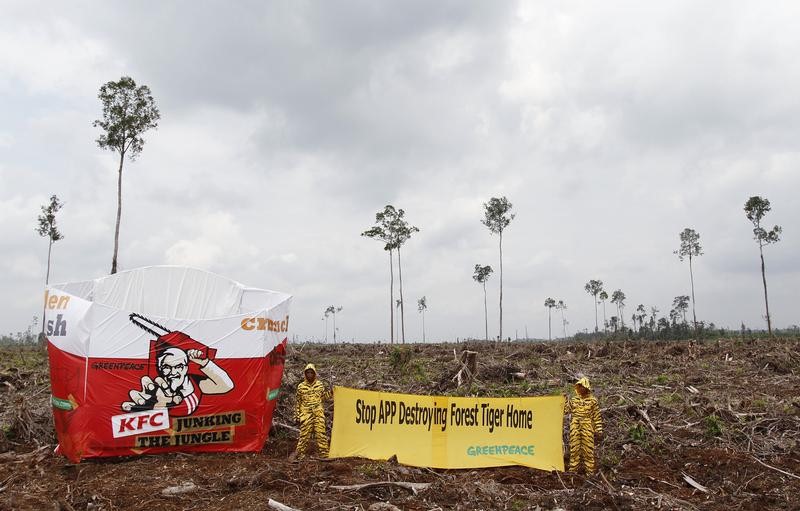
On Tuesday February 5, 2013, Asia Pulp & Paper announced their new Forest Conservation Policy in favour of Indonesia’s rainforests. After much pressure from the public and NGOs who launched a campaigns against them for large-scale clearing of rainforests, their ‘Sustainability Roadmap’ plan includes ending all further development on forested land (including peat forests), reducing greenhouse gas emissions, NGO monitoring, and conflict resolution with communities affected by the development. The campaign against APP was largely publicized by Greenpeace in 2010 which was joined by numerous other organizations and rallied thousands of international supporters from the public who participated through letter-writing and online petitioning. Companies that cut ties with APP after the exposure include KFC and Mattel, and others such as National Geographic confirmed that they would not buy from them.
   It great to hear that the Indonesian Rainforests and all the animals living within them (including but not limited to orangutans, great hornbills, and Bengal tigers) are no longer threatened by APP. Rainforests also provide the planet’s atmosphere with much-needed filtration which every living thing on the planet requires. Also, some resources in the rainforest have been used for medical treatments, and reservation of those resources are necessary for people suffering from such illnesses to be treated. Still, there is much to be done before the rainforest can be considered “saved,” and heightened public awareness and pressure may incite more progress.
   Hopefully this is one of many more steps to be taken in conservation of rainforests. The campaign has raised a lot of public awareness and interest, with the orangutan and Bengal tiger shown as the faces of Indonesian rainforests. APP’s sister company under Sinar Mas, Asia Pacific Resources International (also known as “APRIL”), has been sent a letter, urging them to take similar steps to create a Conservation Policy of their own. It is evident that many consumers will pressure companies for “greener” products, and that it can be affective. With the heightened awareness through media and public participation, events like this may help give a boost in conservation.


Greenpeace activists campaigning against APP. (photo from Greenpeace.org)


References


*This is part of a series of older environmental news summaries.