Showing posts with label deforestation. Show all posts

Thursday, 7 December 2023

Exploring Environmental Impacts of Mined Diamonds - Part 1: The Issues

(Edit: In a rush to get to the bottom-line? Click here to jump to the more positive next part in this series!)

On an Ontario radio station an announcer once spoke about millennials hating diamonds. But as a younger millennial, now that many of my peers are at an age where they are buying engagement rings, I can't say I've noticed particularly strong hatred for the mineral itself. What could definitely be said though is that there is increased interest in the ethics of the way diamond products are produced.

The Kimberley Process Certification Scheme (KPCS) is one method that diamond retailers like Tiffany & Co. have used to dramatically cut the trade of conflict diamonds (aka blood diamonds) used to fund wars. The process includes satisfying minimum requirements, promoting national legislation, increased transparency in practices, internal trade, and a certification process for shipments. The results? The Kimberly Process official website boasts that "participants actively prevent 99.8% of the worldwide trade [of conflict diamonds.]" 

In spite of gaps still left in the pursuit of ethical diamond mining, this is an accomplishment worth celebrating. This is especially significant for an industry that has been a source of income even in impoverished areas. But while the Kimberly Process mitigates some social consequences, it doesn't take into account environmental impacts of mined diamonds. 

This short series will hopefully serve as a collection of info for anyone looking at making an informed decision about purchasing diamonds or their alternatives. The goal also isn't to make anyone feel guilty for any jewelry they might own, but help increase awareness of the impacts of one of many mined commodities from an environmental perspective.

Environmental Impacts of Diamond Mining

Land and Habitat Disruption

Beginning with the most visible impact, all systematic mining practices involve habitat disruption. Forested areas are cleared so miners can have better access to areas rich in the desired resource, and lakes are drained to reach diamonds below. It is estimated that for every carat of diamond mined, over 250 tons of earth must be moved (Constable, 2022; Oluleye).

The excavation and blasting through kimberlite (the rock that surrounds diamonds) required for underground mining also comes with obvious land disturbance.

Even artisanal alluvial mining which results in comparatively less carbon emissions, left unregulated, leaves the door open for unrestricted land and water disruption (Levin Sources, Chupezi et al). That said, because it happens on a smaller scale the direct impacts are also smaller. 

While mine rehabilitation and mine closure practices do exist, this does not leave land disturbance a moot point. In an Imperial College London report on the environmental impacts of diamond mining, the writers quote Professor Saleem Ali, distinguished Professor of Energy and the Environment. Professor Saleem Ali says, “The most significant impact of mined diamonds in environmental terms is likely to be land disturbance and the overall magnitude of this is dependent on the ecosystem in which the mining is occurring."

About Alluvial Mining

The word "Alluvial" comes from Latin alluvius, which means "washed against" (USGS, 2016). Alluvial mining is a method of retrieving minerals that relies on the natural eroding forces of wind and water to transport them from kimberlite rock (igneous rock surrounding the diamond). After erosion, a diamond may be naturally deposited into the sediments at the bottom of a river where a diver can search for them.

Because most alluvial diamond deposits are hard to pinpoint, this type of mining often happens on an artisan basis, informally and unregulated, instead of industrially. It is estimated that 10% of the world’s rough diamonds are sourced via industrial alluvial mining, while a slightly larger 14% are through artisanal or small-scale alluvial diamond mining (diamondfacts.org, n.d.-a).

Alluvial mining is labour-intensive and uses much more rudimentary materials than other forms. While digging for information on the subject, I came across the artfully-drawn story of artisanal diamond-digger's job in Sierra Leone shared on vimeo here:

Credit: The Divers of Sewa (2020) by Laurent Cartier on Vimeo https://vimeo.com/444162165

Via: https://www.aureusboutique.com/abx/what-is-alluvial-mining

One expression from an artisan diver that particularly stands out is, "There are diamonds. You can work, you can fail, you can work you can fail. But the day you find, you'll prosper.... Sometimes, you can be unlucky for one or two months, but one day when you find a diamond you'll forget all that time you failed."

This quote from a tenacious worker leaves no question that diamonds themselves are both a source of income, and something that should continue to be kept in perspective as a luxury item. 

Air Pollution

Air pollution from diamond mining includes particulate matter that is transported by wind, nitrous oxide emissions, sulphur oxide emissions, as well as greenhouse gas emissions from fuel consumption (Oluleye). 

Professor Saleem Ali went on to say, "there can be additional water use and biodiversity impacts dependent on where the mining is occurring. The carbon emissions of mining are highly dependent on location. Cold climates such as Siberia or Northern Canada have larger carbon emission impacts. Artisanal alluvial diamond mining has less carbon emission impacts.”

Damage to Aquatic Ecosystems

Whether from sedimentation or disrupting particles at the bottom of water bodies, mercury pollution, or changing water ways, the mining of diamonds disrupts aquatic ecosystems. 

Since diamond extraction relies mainly on water rather than toxic chemicals, fortunately toxic pollutants are less of an issue. Meanwhile, water recycling and reduced water consumption is a larger focus (diamondfacts.org, n.d.-b).

Myth or Fact: Are natural salt-and-pepper diamonds more environmentally friendly?

From what I could gather, this is a myth.

From a social perspective artisan alluvially mined impure diamonds could be sold for more if there is increased demand for them in jewelry, so more money could go to artisan workers.

But from an environmental perspective, mined impure diamonds are no less damaging than purely clear ones. They are less in demand for jewelry but they would still be used for industrial purposes and require the same environmental costs to mine. (That said if you particularly like the salt-and-pepper look but are concerned about environmental impacts, see the box on impure lab-grown gemstones in part 2 of this series).

That's a lot to process. I'm looking to buy a diamond product, what do I do with this information?

It is up to each person to decide for themselves what is an acceptable buy. The changes in the status quo mentioned in Part 1 regarding blood diamonds is indeed a step in the right direction, and diamonds are far from the only mined product that we use. The goal of this post is not to guilt people on a single smaller part of a major problem.

However, if you are looking to buy a piece of jewelry ultimately for a good feeling but also with environmental consciousness, the good news is there are options!

Stay tuned for Part 2 on awareness and alternatives.

~~

Sources

Chupezi, T. J., Ingram, V., & Schure, J. (n.d.). Impacts of artisanal gold and diamond mining on livelihoods and ... - CIFOR. CIFOR. https://www.cifor.org/publications/pdf_files/Books/BChupezi0901.pdf

Constable, H. (2022, February 24). How diamonds are going green. BBC News. https://www.bbc.com/future/article/20200207-the-sparkling-rise-of-the-lab-grown-diamond

diamondfacts.org. (n.d.-a). Alluvial diamond mining fact sheet. https://www.diamondfacts.org/pdfs/media/media_resources/fact_sheets/Alluvial_Mining_Background.pdf

diamondfacts.org. (n.d.-b). Diamond Mining and the environment fact sheet. https://diamondfacts.org/pdfs/media/media_resources/fact_sheets/Diamond_Mining_Environment_Fact_Sheet.pdf

The Divers of Sewa. (2020). vimeo. Retrieved December 6, 2023, from https://vimeo.com/444162165.

Le Temps. (2018, May 10). Diamond trade still fuels human suffering. Human Rights Watch. https://www.hrw.org/news/2018/05/10/diamond-trade-still-fuels-human-suffering

Levin Sources. (2020, November). How to bring about Forest-smart mining: Strategic Entry Points for ... https://www.levinsources.com/assets/pages/How-to-bring-about-forest-smart-mining-strategic-entry-points-for-institutional-donors.pdf

Oluleye, G. (n.d.). Imperial Consultants. imperial-consultants.co.uk. https://www.imperial-consultants.co.uk/wp-content/uploads/2021/02/Final-report-Environmental-Impacts-of-Mined-Diamonds-updated-8-21.pdf

USGS. (2016, June 20). EarthWord–alluvial fan: U.S. geological survey. USGS. https://www.usgs.gov/news/science-snippet/earthword-alluvial-fan#:~:text=Alluvial%20comes%20from%20the%20Latin,which%20meant%20%E2%80%9Cwashed%20against.%E2%80%9D

Edited 2023-12-08

Tuesday, 17 December 2019

On the current Plight of Koalas

Image source: Majesticanimals.net/Heartbreaking images
of confused koala after discovering its home has been cut down

The article attached to this photo explains that this koala survived and is ok. She had suffered some injuries and was taken to an animal hospital where she is in much better condition.

Also, in correction of a previous post, fortunately the report in November 2019 that koalas are "functionally extinct" was erroneous. Though they do still need our help, to be considered "functionally extinct" a species must fall within the criteria below:

1. The population is so low that they no longer play a significant role in their ecosystem. Eg. There are so few they don't put significant dent in what they prey on

2. "A population that is no longer viable", or there are none left able to produce.

3. "Finally, functionally extinct can refer to a small population that, although still breeding, is suffering from inbreeding that can threaten its future viability".

Although the label of "functionally extinct" was erroneous, it did come from the very real sitaution that they are in trouble.

If you would like to donate to help koalas specifically, Living With Koalas has put together a nice list of charities to help them:
http://livingwithkoalas.com.au/home/koala-charities/

Sources:
PBS
https://www.pbs.org/newshour/science/koalas-may-be-functionally-extinct-but-what-does-that-mean
majesticanimals.net https://www.majesticanimals.net/heartbreaking-images-of-confused-koala-after-discovering-its-home-has-been-cut-down?fbclid=IwAR1tco5hYcynTQeESOwBdCSQNACQuB-YTQFHrBu44gUhcXBFBcocExqZTuY

Written 2019-10-21, Posted to sister blogs NN and L~W 2019-12-17, edited 2019-12-20, 2020-01-05, 2020-07-19

Monday, 11 July 2016

What's Up With Palm Oil? Part 1: History


What do ice cream, instant noodles, margarine, lipstick, and soap have in common?

A lot of us have probably used some in the last two weeks, and they also may contain palm oil.

Everything we consume has some sort of impact on the environment and many concerned citizens are eager to find new ways to make more sustainable choices, but honestly my strawberry ice cream cone was not at the top of my list of changes to make for a better world.

Palm oil is a widely-used vegetable oil , but is often produced unsustainable ways and is linked to environmental and social issues.

So what's up with Palm oil?

A (Brief) History of Palm Oil

(To read the full report, see "History of Palm Oil" from The Cambridge World History of Food 2 Volume Boxed Set by Kenneth F. Kiple and Kriemhild Coneรจ Ornelas at http://coconutoil.com/palm_oil_history/) 

Elaeis guineensis, or the oil palm, is a tree native to West Africa. It was likely a food source for indigenous people in unrecorded history, found in ancient Egyptian tombs, and its use in cooking was written about in the journals of some European travelers from the mid 15th century. Today it remains an ingredient in cherished dishes in cultures around the world; trans fat-free, nutritious, containing antioxidants, and used in making many tasty foods.

Upon expansion trade of the red palm oil got its hands dirty, supplying vessels of the transatlantic slave trade. It was used for candlemaking and as a lubricant for machinery, and the demand for palm oil in Europe increased during the British Industrial Revolution it became a modest exporting trade for farmers in Western Africa while also farming for local usage. It is believed that often oil palm trees were self-seeded, ground about by their own natural processes, even possibly after the 1900s European plantations were established in Southeast Asia and Central Africa.

The demand continued to grow ever larger as palm oil slipped its way into Western foods, especially because of non-hydrogenated margarine. Today a lot of us have been warned about the health risks associated with the process of hydrogenation because of trans fats, and this has been a key point in the common butter vs. margarine debate. However, eventually  it was found that palm oil could be processed in a way that allowed it to be used in margarine without undergoing hydrogenation as other vegetable oils may. 

Although in the 1940's the use of palm oil in Western cultures slowed when there were interruptions in trade with Asia, when butter was in short supply during the war people were often encouraged to use margarine.

From there a grading system was developed and made standard by The Produce Control Board and later Nigerian Oil Palm Produce Marketing Board, which motivated producers to develop better processing techniques.

... Today & the RSPO

Today we are at a point in history where sellers of palm oil have been faced with a new challenge; a challenge ensure it is farmed and produced sustainably. Palm oil has a speckled past, but the Roundtable on Sustainable Palm Oil (or RSPO) is now challenging traders of palm oil to make a clean slate, and clean up the act for the future.

This is the RSPO's Mission and Vision statement taken directly from their website:
  • "Advance the production, procurement, finance and use of sustainable palm oil products
  • Develop, implement, verify, assure and periodically review credible global standards for the entire supply chain of sustainable palm oil
  • Monitor and evaluate the economic, environmental and social impacts of the uptake of sustainable palm oil in the market
  • Engage and commit all stakeholders throughout the supply chain, including governments and consumers." - rspo.org
Basically an RSPO certification compares the means a trader or palm oil with a certain standard so as to minimize negative impacts on the environment, animals, and people.

The oil used in ramen noodles may seem arbitrary, but sustainable or unsustainable farming of it is linked with larger environmental issues that are getting closer to home for people.

Stay tuned for Part 2 of "What's Up With Palm Oil?" to read more about the issues surrounding palm oil, the significance of RSPO, and what each one of us can do to help clean up the act.

In the meantime...
WWF created a satirical trailer, "Unseen" for the drama that is gradually unfolding around unsustainable palm oil. On the surface it may sound far less important and glamorous than the fight against mass deforestation and habitat loss, climate change, or indigenous rights, but the sustainable palm oil is an ingredient affecting all of the above.

Sources

http://www.worldwildlife.org/pages/which-everyday-products-contain-palm-oil 

http://coconutoil.com/palm_oil_history/

http://www.soyatech.com/Palm_Oil_Facts.htm

http://www.rspo.org/about/sustainable-palm-oil

http://www.rspo.org/about


Saturday, 9 February 2013

APP Resolves to Stop Clearing Indonesian Rainforests


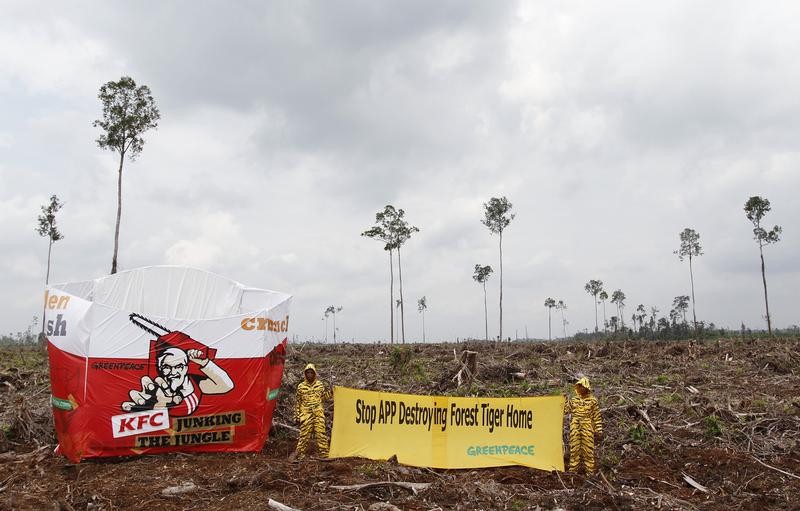
On Tuesday February 5, 2013, Asia Pulp & Paper announced their new Forest Conservation Policy in favour of Indonesia’s rainforests. After much pressure from the public and NGOs who launched a campaigns against them for large-scale clearing of rainforests, their ‘Sustainability Roadmap’ plan includes ending all further development on forested land (including peat forests), reducing greenhouse gas emissions, NGO monitoring, and conflict resolution with communities affected by the development. The campaign against APP was largely publicized by Greenpeace in 2010 which was joined by numerous other organizations and rallied thousands of international supporters from the public who participated through letter-writing and online petitioning. Companies that cut ties with APP after the exposure include KFC and Mattel, and others such as National Geographic confirmed that they would not buy from them.
   It great to hear that the Indonesian Rainforests and all the animals living within them (including but not limited to orangutans, great hornbills, and Bengal tigers) are no longer threatened by APP. Rainforests also provide the planet’s atmosphere with much-needed filtration which every living thing on the planet requires. Also, some resources in the rainforest have been used for medical treatments, and reservation of those resources are necessary for people suffering from such illnesses to be treated. Still, there is much to be done before the rainforest can be considered “saved,” and heightened public awareness and pressure may incite more progress.
   Hopefully this is one of many more steps to be taken in conservation of rainforests. The campaign has raised a lot of public awareness and interest, with the orangutan and Bengal tiger shown as the faces of Indonesian rainforests. APP’s sister company under Sinar Mas, Asia Pacific Resources International (also known as “APRIL”), has been sent a letter, urging them to take similar steps to create a Conservation Policy of their own. It is evident that many consumers will pressure companies for “greener” products, and that it can be affective. With the heightened awareness through media and public participation, events like this may help give a boost in conservation.


Greenpeace activists campaigning against APP. (photo from Greenpeace.org)


References


*This is part of a series of older environmental news summaries.