Showing posts with label wildlife. Show all posts

Saturday, 9 December 2023

Waterfowl to Look out for in Southern Ontario This Winter

With the snow coming with the cold weather many nature-lovers are preparing to bundle up and find things to do outdoors.

My personal favourite thing to do over the winter is look for migratory birds passing through. If you're in the Greater Toronto Area, here are a few types of birds to keep an eye open for:


Hooded Merganser (Lophodytes cucullatus)

The hooded merganser is distinct by the dramatic crest of white or copper on its head that can expand or collapse. Like many other birds, this species shows clear sexual dimorphism (where males and females look different), with the females not having the high-contrasting black and white markings that males have. 


Trumpeter Swan (Cygnus buccinator)

A symbol of lifelong love, swans mate for life and easily steal the spotlight amoung other migratory waterfowl. Their long necks, high stature, and striking white colour make them easy to spot. They are often seen in small groups, sometimes with younger swans with darker feathers. Trumpeter swans particularly have all black bills. 


Pied-billed Grebe (Podilymbus podiceps)

These cute little birds are not to be confused with ducks. They have lobed toes that they use to scoot across the water's surface, often bobbing their heads forward as they swim. They are solitary and can also be seen diving, but will not dive as deep as loons will. 

Bufflehead (Bucephala albeola)

Buffleheads are shy towards other species of birds and towards humans. Their shy nature can make them difficult to get close enough to photograph, but they can be easily spotted often in pairs or with their flocks as they migrate. They also show sexual dimorphsm, with females being darker than males.


Canada Goose (Branta canadensis)
During the wintertime this familiar waterfowl can be seen in droves, with hundreds and hundreds flying into bodies of water as they migrate. Known for their aggressive nature, many people have stories of being chased or attacked by the notorious bird, earning it the nickname "cobra chicken".


American coot (Fulica americana)
Rarer in Canada than the United States, the American coot may be spotted with a silhouette like a mallard's in the water, or with a much more distinct shape when it stands. American coots have red eyes and a white bill that extends to their forehead with red on the top.


Long-tailed duck (Clangula hyemalis)

It's not so clear in the photos I was able to get, but the long-tailed duck's name is descriptive of it's most obvious feature on males: long feathers on its tail arching upwards. By contrast, females are brown and white and do not have the long tail.


Mallard (Anas platyrhynchos) 

This common duck lives around the Greater Toronto Area year-round, but can be seen migrating in flocks over the wintertime. Females are neutral brown, while males have green iridescent heads and grey-brown bodies. Shown in the picture on the left is an albino Mallard spotted with a regularly-coloured male companion.

Common Loon (Gavia immer)

Popular with tourists year-round in Algonquin Park, loons can be seen migrating through the Toronto area over the winter months. They will most often be seen solitary, more deeply submerged than mallards, and often diving. 

Thursday, 7 December 2023

Exploring Environmental Impacts of Mined Diamonds - Part 1: The Issues

(Edit: In a rush to get to the bottom-line? Click here to jump to the more positive next part in this series!)

On an Ontario radio station an announcer once spoke about millennials hating diamonds. But as a younger millennial, now that many of my peers are at an age where they are buying engagement rings, I can't say I've noticed particularly strong hatred for the mineral itself. What could definitely be said though is that there is increased interest in the ethics of the way diamond products are produced.

The Kimberley Process Certification Scheme (KPCS) is one method that diamond retailers like Tiffany & Co. have used to dramatically cut the trade of conflict diamonds (aka blood diamonds) used to fund wars. The process includes satisfying minimum requirements, promoting national legislation, increased transparency in practices, internal trade, and a certification process for shipments. The results? The Kimberly Process official website boasts that "participants actively prevent 99.8% of the worldwide trade [of conflict diamonds.]" 

In spite of gaps still left in the pursuit of ethical diamond mining, this is an accomplishment worth celebrating. This is especially significant for an industry that has been a source of income even in impoverished areas. But while the Kimberly Process mitigates some social consequences, it doesn't take into account environmental impacts of mined diamonds. 

This short series will hopefully serve as a collection of info for anyone looking at making an informed decision about purchasing diamonds or their alternatives. The goal also isn't to make anyone feel guilty for any jewelry they might own, but help increase awareness of the impacts of one of many mined commodities from an environmental perspective.

Environmental Impacts of Diamond Mining

Land and Habitat Disruption

Beginning with the most visible impact, all systematic mining practices involve habitat disruption. Forested areas are cleared so miners can have better access to areas rich in the desired resource, and lakes are drained to reach diamonds below. It is estimated that for every carat of diamond mined, over 250 tons of earth must be moved (Constable, 2022; Oluleye).

The excavation and blasting through kimberlite (the rock that surrounds diamonds) required for underground mining also comes with obvious land disturbance.

Even artisanal alluvial mining which results in comparatively less carbon emissions, left unregulated, leaves the door open for unrestricted land and water disruption (Levin Sources, Chupezi et al). That said, because it happens on a smaller scale the direct impacts are also smaller. 

While mine rehabilitation and mine closure practices do exist, this does not leave land disturbance a moot point. In an Imperial College London report on the environmental impacts of diamond mining, the writers quote Professor Saleem Ali, distinguished Professor of Energy and the Environment. Professor Saleem Ali says, “The most significant impact of mined diamonds in environmental terms is likely to be land disturbance and the overall magnitude of this is dependent on the ecosystem in which the mining is occurring."

About Alluvial Mining

The word "Alluvial" comes from Latin alluvius, which means "washed against" (USGS, 2016). Alluvial mining is a method of retrieving minerals that relies on the natural eroding forces of wind and water to transport them from kimberlite rock (igneous rock surrounding the diamond). After erosion, a diamond may be naturally deposited into the sediments at the bottom of a river where a diver can search for them.

Because most alluvial diamond deposits are hard to pinpoint, this type of mining often happens on an artisan basis, informally and unregulated, instead of industrially. It is estimated that 10% of the world’s rough diamonds are sourced via industrial alluvial mining, while a slightly larger 14% are through artisanal or small-scale alluvial diamond mining (diamondfacts.org, n.d.-a).

Alluvial mining is labour-intensive and uses much more rudimentary materials than other forms. While digging for information on the subject, I came across the artfully-drawn story of artisanal diamond-digger's job in Sierra Leone shared on vimeo here:

Credit: The Divers of Sewa (2020) by Laurent Cartier on Vimeo https://vimeo.com/444162165

Via: https://www.aureusboutique.com/abx/what-is-alluvial-mining

One expression from an artisan diver that particularly stands out is, "There are diamonds. You can work, you can fail, you can work you can fail. But the day you find, you'll prosper.... Sometimes, you can be unlucky for one or two months, but one day when you find a diamond you'll forget all that time you failed."

This quote from a tenacious worker leaves no question that diamonds themselves are both a source of income, and something that should continue to be kept in perspective as a luxury item. 

Air Pollution

Air pollution from diamond mining includes particulate matter that is transported by wind, nitrous oxide emissions, sulphur oxide emissions, as well as greenhouse gas emissions from fuel consumption (Oluleye). 

Professor Saleem Ali went on to say, "there can be additional water use and biodiversity impacts dependent on where the mining is occurring. The carbon emissions of mining are highly dependent on location. Cold climates such as Siberia or Northern Canada have larger carbon emission impacts. Artisanal alluvial diamond mining has less carbon emission impacts.”

Damage to Aquatic Ecosystems

Whether from sedimentation or disrupting particles at the bottom of water bodies, mercury pollution, or changing water ways, the mining of diamonds disrupts aquatic ecosystems. 

Since diamond extraction relies mainly on water rather than toxic chemicals, fortunately toxic pollutants are less of an issue. Meanwhile, water recycling and reduced water consumption is a larger focus (diamondfacts.org, n.d.-b).

Myth or Fact: Are natural salt-and-pepper diamonds more environmentally friendly?

From what I could gather, this is a myth.

From a social perspective artisan alluvially mined impure diamonds could be sold for more if there is increased demand for them in jewelry, so more money could go to artisan workers.

But from an environmental perspective, mined impure diamonds are no less damaging than purely clear ones. They are less in demand for jewelry but they would still be used for industrial purposes and require the same environmental costs to mine. (That said if you particularly like the salt-and-pepper look but are concerned about environmental impacts, see the box on impure lab-grown gemstones in part 2 of this series).

That's a lot to process. I'm looking to buy a diamond product, what do I do with this information?

It is up to each person to decide for themselves what is an acceptable buy. The changes in the status quo mentioned in Part 1 regarding blood diamonds is indeed a step in the right direction, and diamonds are far from the only mined product that we use. The goal of this post is not to guilt people on a single smaller part of a major problem.

However, if you are looking to buy a piece of jewelry ultimately for a good feeling but also with environmental consciousness, the good news is there are options!

Stay tuned for Part 2 on awareness and alternatives.

~~

Sources

Chupezi, T. J., Ingram, V., & Schure, J. (n.d.). Impacts of artisanal gold and diamond mining on livelihoods and ... - CIFOR. CIFOR. https://www.cifor.org/publications/pdf_files/Books/BChupezi0901.pdf

Constable, H. (2022, February 24). How diamonds are going green. BBC News. https://www.bbc.com/future/article/20200207-the-sparkling-rise-of-the-lab-grown-diamond

diamondfacts.org. (n.d.-a). Alluvial diamond mining fact sheet. https://www.diamondfacts.org/pdfs/media/media_resources/fact_sheets/Alluvial_Mining_Background.pdf

diamondfacts.org. (n.d.-b). Diamond Mining and the environment fact sheet. https://diamondfacts.org/pdfs/media/media_resources/fact_sheets/Diamond_Mining_Environment_Fact_Sheet.pdf

The Divers of Sewa. (2020). vimeo. Retrieved December 6, 2023, from https://vimeo.com/444162165.

Le Temps. (2018, May 10). Diamond trade still fuels human suffering. Human Rights Watch. https://www.hrw.org/news/2018/05/10/diamond-trade-still-fuels-human-suffering

Levin Sources. (2020, November). How to bring about Forest-smart mining: Strategic Entry Points for ... https://www.levinsources.com/assets/pages/How-to-bring-about-forest-smart-mining-strategic-entry-points-for-institutional-donors.pdf

Oluleye, G. (n.d.). Imperial Consultants. imperial-consultants.co.uk. https://www.imperial-consultants.co.uk/wp-content/uploads/2021/02/Final-report-Environmental-Impacts-of-Mined-Diamonds-updated-8-21.pdf

USGS. (2016, June 20). EarthWord–alluvial fan: U.S. geological survey. USGS. https://www.usgs.gov/news/science-snippet/earthword-alluvial-fan#:~:text=Alluvial%20comes%20from%20the%20Latin,which%20meant%20%E2%80%9Cwashed%20against.%E2%80%9D

Edited 2023-12-08

Tuesday, 17 December 2019

On the current Plight of Koalas

Image source: Majesticanimals.net/Heartbreaking images
of confused koala after discovering its home has been cut down

The article attached to this photo explains that this koala survived and is ok. She had suffered some injuries and was taken to an animal hospital where she is in much better condition.

Also, in correction of a previous post, fortunately the report in November 2019 that koalas are "functionally extinct" was erroneous. Though they do still need our help, to be considered "functionally extinct" a species must fall within the criteria below:

1. The population is so low that they no longer play a significant role in their ecosystem. Eg. There are so few they don't put significant dent in what they prey on

2. "A population that is no longer viable", or there are none left able to produce.

3. "Finally, functionally extinct can refer to a small population that, although still breeding, is suffering from inbreeding that can threaten its future viability".

Although the label of "functionally extinct" was erroneous, it did come from the very real sitaution that they are in trouble.

If you would like to donate to help koalas specifically, Living With Koalas has put together a nice list of charities to help them:
http://livingwithkoalas.com.au/home/koala-charities/

Sources:
PBS
https://www.pbs.org/newshour/science/koalas-may-be-functionally-extinct-but-what-does-that-mean
majesticanimals.net https://www.majesticanimals.net/heartbreaking-images-of-confused-koala-after-discovering-its-home-has-been-cut-down?fbclid=IwAR1tco5hYcynTQeESOwBdCSQNACQuB-YTQFHrBu44gUhcXBFBcocExqZTuY

Written 2019-10-21, Posted to sister blogs NN and L~W 2019-12-17, edited 2019-12-20, 2020-01-05, 2020-07-19

Monday, 25 February 2019

Tab For a Cause Chrome Extension, feat. WWF for the next 19 hours!

Hey guys,

Just found this Chrome extension that allows you to rise money for a charity every time you open a new tab. Pretty much what happens is that the money comes from the ads placed around the new tab screen that opens up.

Click here to sign up using this referral, which will also add 350 bonus "hearts" to be donated through the Nature Nimbus operator's account.

The Nonprofit currently featured happens to be WWF/World Wildlife Fund. They do a lot of amazing work for conservation and education, and need about another 1.8 million hearts to be donated in the next 19 hours to reach their goal of 6 mil, and it would be great to see how close they can get. Let's get tabbing!

Best,

Melody

Thursday, 18 February 2016

Seriously, Don't Touch Giant Hogweed!

Originally this post had a more abrupt title, then less so compromised with regular casing and one exclamation point. Just felt like it was important to get the message across.

Many people have had unpleasant experiences with poison ivy and I can attest to carelessly running through stinging nettle several times partly regretting the little renegade session, but Giant Hogweed is more than just a pain-in-the-neck to just wash away, and is in a league of it's own for "don't touch that plant."

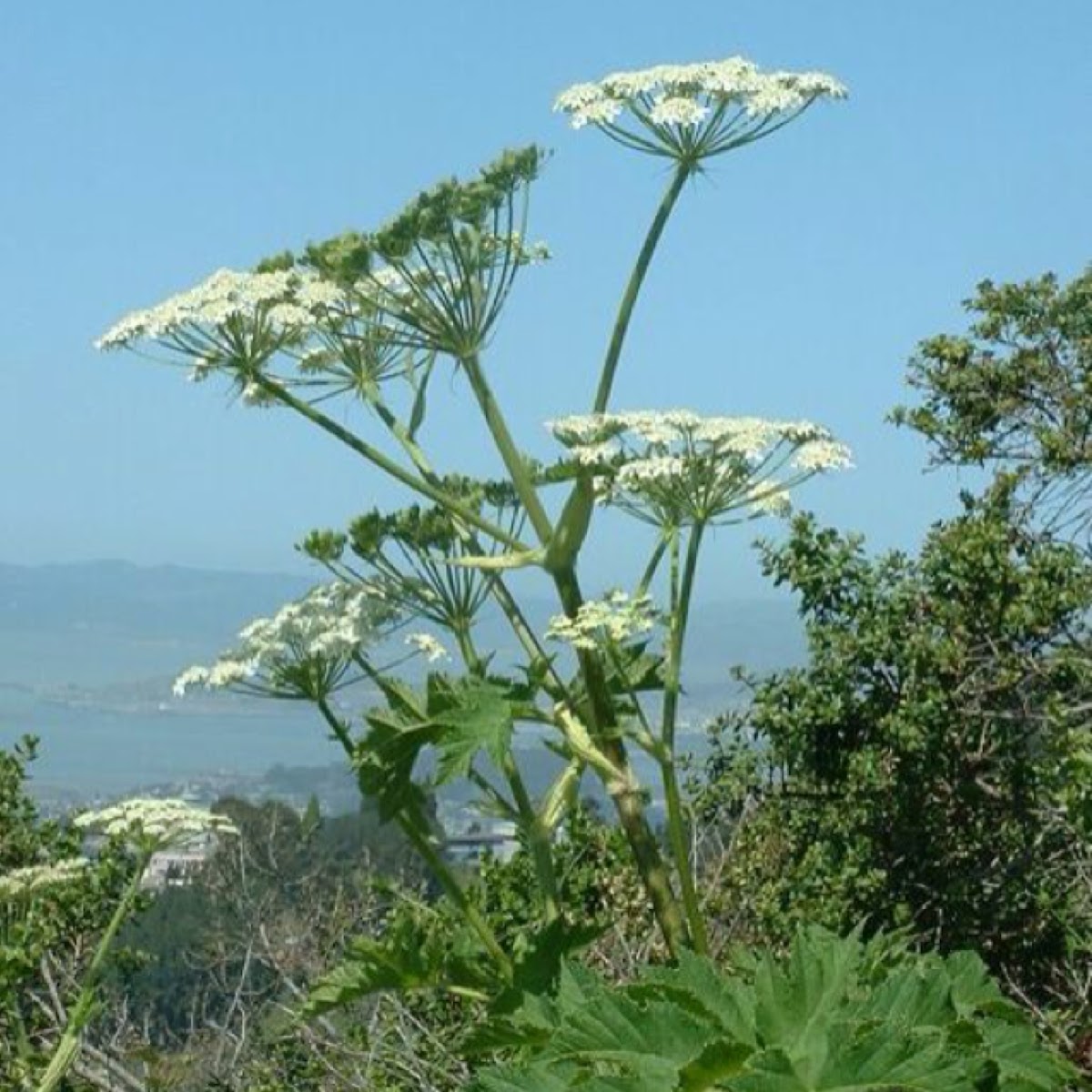
It looks like a giant version of Cow Parsnip and Queen Anne's Lace. 
Here is a webpage with a comparison chart: http://www.invadingspecies.com/invaders/plants-terrestrial/wild-parsnip/
Giant Hogweed photo by Project Noah's rayrodriguez1027
Giant Hogweed can grow over 2 metres in height. In addition to its round clusters of white flowers, it has purple spots and tiny white hairlike filaments on the stem. Before it's bloom in mid-August it is also much lower to the ground and without its distinct flowers.

While its mini-me is evocative of the delicate crochet patterns that might adorn the collarbone of her Majesty, Giant Hogweed could bedeck your skin with third degree burns, or cause blindness if even a single drop gets in your eye.

The effects are not immediate, but this plant is phototoxic and the oils will burn your skin after being exposed to light, potentially permanent effects worsening over the course of days without treatment. If you do accidentally come into contact with its toxic oils on your skin, wash the area well with soap and warm water as soon as possible and avoid sunlight for two days, and see a physician.*

If you accidentally get any on your hands, do not rub your eyes!

*Even in the age of knowledge, Google searches, and Mayoclinic, the internet doesn't replace the care of a health care professional. With Giant Hogweed effects may not be immediate but can cause permanent damage without the help of a physician. Including to tough guys (and gals) who "don't go to the doctor".
phototoxicity: (aka photoirritation) A toxic response that occurs after the exposure of skin to certain chemicals and light. It can also occur after systemic (oral or intravenous) administration.
- EURL-ECVAM (https://eurl-ecvam.jrc.ec.europa.eu/validation-regulatory-acceptance/topical-toxicity/phototoxicity)


Queen Anne's Lace is a part of the carrot family so I'm guessing giant hogweed is as well. This means that if you're trying to rid your garden of this pain-in-the-neck relative you gotta be careful not only to not touch it,  but to take out the tap root from the ground also.

Giant Hogweed is an invasive species from Asia which (surprise-surprise) was introduced by people, first to England, then to Canada including Atlantic Canada, B.C., Ontario, and Quebec. It competes with native species for resources, and the loosening of soil even after it dies or hibernates during the winter can cause soil erosion.

If you see giant hogweed in your renegading through the forst, reporting the sighting would really help the local environment and fellow outdoorsmen: http://www.eddmaps.org/ontario/ 
(To all who do this, thank you.)

Moral of the story: don't touch giant hogweed.

References*
Ontario's Invadin Species Awareness Program. (n.d.). Giant Hogweed. Retrieved February 18, 2016, from http://www.invadingspecies.com/invaders/plants-terrestrial/giant-hogweed/

 Jakuboski, Samantha. (2011, July 17). CAUTION: Giant Hogweed might be growing in your own backyard. Retrieved February 18, 2016, from http://www.nature.com/scitable/blog/green-science/caution_giant_hogweed_might_be 

EURL-ECVAM. (2012). Phototoxicity. Retrieved February 18, 2016, from https://eurl-ecvam.jrc.ec.europa.eu/validation-regulatory-acceptance/topical-toxicity/phototoxicity 

Santa Maria, Cheryl. (2015, July 22). Plant that can cause third-degree burns popping up in Canada. Retrieved February 18, 2016, from http://www.theweathernetwork.com/news/articles/plant-that-can-cause-third-degree-burns-popping-up-in-canada/54604/ 


Santa Maria, Cheryl. (2015, June 2). Bloodroot and 7 other dangerous plants: How to identify each. Retrieved February 18, 2016, from http://www.theweathernetwork.com/news/articles/toxic-plants-found-in-canada/52042/ 

Photo by Project Noah's rayrodriguez1027, from  http://www.projectnoah.org/spottings/8648105

*Apologies for the tiny font... can't seem to increase the size!

Wednesday, 23 December 2015

Algonquin Park 2015


After much waiting and attempts at getting photos off a hard-to-crack device, here is a link to an album of photos from Algonquin Park this August.

(https://goo.gl/photos/1GvKxfyKPuRiTXRw9)

We had a fantastic time and over the next few days I'll be updating this photo journal (which still does not have identifiable faces, but maybe we'll get to that point eventually).

Tuesday, 24 March 2015

Picking the Right Fish in the Sea: Selecting Sustainable Seafood

For generations the  ocean has been both a source of awe
and inspiration as well as physical needs. 
Have you ever had the chance to watch a wave from the ocean roll onto the shore? Somewhere beyond the horizon and farther than you can see, all the right motions started that wave, and you can only imagine all the life and stones and forgotten wrecks that it passed over on its journey.


Sushi is a personal family favourite for making and eating,
but the imitation crab should be selected carefully.
The vast blue seas have long been a source of awe, inspiration, and resources for humans, but as with anything, unsustainable human activity can have serious consequences to marine wildlife and ecosystems (and by inevitable extension, to humans). While the practices place direct impacts on marine ecosystems, consumers have the power the either fuel that damage or reduce it back based on where we spend money.

If you are vegetarian or vegan than you have already eliminated that problem entirely in your case, but for fellow fish-eaters, some organizations have developed research tools to help select the right fish in the sea (for your plate).

Some people reading this may have stopped with the thought, "what about the wellbeing of the people who rely on fishing as a livelihood?" This is a valid concern regardless of how or what they catch. However, if the marine ecosystem collapses then the same fish populations they must draw from will be adversely affected as well as other species that are connected to it. Put simply: Hurt the fish, no fish to catch, no fish to sell, and no fish to eat.

Many people have depended on fishing for generations, but with changes in technology and fishing methods what once was a sustainable tradition has gone sadly overboard in many cases. It is for the long-term benefit of both humans and wildlife that we make more sustainable choices. 


"When the last tree has been cut, the last fish caught, the last river poisoned, only then will we realize that one cannot eat money." - Native American Saying (source: http://quoteinvestigator.com/2011/10/20/last-tree-cut/)

There are a number of online resources but here are a few that I have found to be particularly helpful which evaluate seafoods based on when, how, and what is being caught relative to sustainability. When using these to compare fish and other seafood products remember to check for the specific species, where it came from, and the method (eg. troll, wild, farmed). 


Sea Choice (http://www.seachoice.org/) is a nice and full online database with lots of straight-to-the-point charts. If you search something like "tuna" it is easy to compare various options all side-by-side, and if you would like more details you can click on the specific name.

This database is extensive and has easy-to-compare charts for comparing different variants which is good because one detail can make all the difference between 'good choice' and 'stay away'. When researching something like 'tuna' which renders a long list of results, the search function (control+F on Windows) can be very useful in highlighting specific criteria when evaluating a specific product.

Sea choice was also sourced for David Suzuki's Top 10 Sustainable Seafood Picks (http://www.davidsuzuki.org/what-you-can-do/food-and-our-planet/suzukis-top-10-sustainable-seafood-picks/). From the graphics to immediately listing "Ask For" and "Avoid" for each type, I love the intuitive layout of this list. It immediateky addresses questions people will probably have and this flow continues under "More>>" which includes not only cooking information and a recipe but things to learn about the animal itself.

Although it may not feel good to think about how the animal your are eating was once alive, it can encourage respect. Learning about the species as wildlife including the way it once looked and the things it would have done can help encourage deeper respect and appreciation for it.

Monterey Bay Aquarium's Seafood Watch (http://www.seafoodwatch.org/) is another online database which like Sea Choice includes important details. Although details are not always given immediately, the strength of this one lies in the portability of a free app which does not require wi-fi once updates are downloaded (great for grocery shopping), and printable guides.  California rolls are a family favourite in our house for eating and a benefit when we make our own is being able to be more aware of the source of fish we use in it and make choices accordingly. If you like sushi, the Monterey Bay Aquarium's Seafood Watch also has a sushi guide.

If you're interested in reading more about sustainable eating, here is an older post with a few more tips. (http://naturenimbus.blogspot.ca/2014/10/world-food-day-some-tips-to-digest.html).

Tuesday, 17 March 2015

Pre-Spring Navigation Updates

Spring is approaching fast and it has been a while since my last NatureNimbus post but it has been even longer since my last Project Noah one so I added some of those and this is just an update.

Project Noah is a website where citizen scientists around the globe can share original photos of wildlife including plants, animals, fungi and 'other', comment and favourite photos, and help fellow nature-lovers identify certain species. It is a great online community with lots of experts, so if your're looking for a place to browse share, and learn about wildlife, Project Noah just may be the thing you're looking for.

You can browse my recent posts by clicking on "Project Noah" at the top of the page in the navigation section under the site name, and here's a sneak peek to a few more that I will be posting next:


     You also may have noticed the new "Lunar-Winds" links as well. Not too long ago I started another blog  for more personal and artsy stuff, Lunar-Winds, but even if less frequent the science-related posts will continue here here on Nature Nimbus. 
     Until next time!

Tuesday, 17 December 2013

The Real Costs of Parathion


     The conflict of human convenience and the wellbeing of ecosystems is a repeating issue. Parathion (usually  referring to ethyl parathion, sometimes methyl parathion), is an effective insecticide and one of the most toxic organphosphates, proved to be sometimes fatal to humans and other animals. The original intent for producing and using parathion as an insecticide are not malicious, however with more recent information the risks have become more apparent. The convenience of using parathion is not worth the consequences to natural ecosystems and human health.
An Effective Method
     Parathion is an effective and relatively cheap insecticide. It kills unwanted insect 'pests' by disrupting their nerve impulses. Pest control has played a large role in farming and the mass production of food to feed millions of people, and is also part of the monetary success for individual farmers and overall economies. Pesticides are especially needed for monocultures of food that resulted from the Green Revolution of mass factory farming, as an entire culture would be susceptible to unwanted insects. The method of factory farming has helped humans avoid Thomas Malthus' prediction that starvation would overtake the world by the year 2000, however, the use of pesticides is among the many rising issues associated with factory farming, and there are safer options than parathion such as introducing a natural predator or genetically modifying crops so that they are less susceptible to the pest. Many organic farmers have successfully raised crops without the use of any pesticides, as all pesticides do have the potential for adverse side effects. One of the reasons parathion is used is because its high toxicity makes it highly effective, but it also highly effective on other non-targeted species.

A Toxic Threat
     Other living things are not immune to the devastating effects parathion has on an organism, Parathion has proven to be especially toxic to birds such as grouse, pigeons, red-winged blackbirds, and sparrows. Amounts of dermal exposure may be fatal for birds such as house sparrows, which have 50% mortality rate after 24 hours of dermal exposure of 1.8 mg / kg on their feet. Not only do they receive exposure through the air when it is sprayed, but also because of what they prey on. Ethyl parathion has been pinned as the direct cause of death for birds in numerous instances, for example the death of fourteen Mississippi kites from insects that were contaminated by parathion in a nearby cotton field in 1994. Another occurrence was in 1982, New York, when almost 3200 birds of various species were found dead in a field containing scattered rye seeds contaminated with ethyl parathion. As birds consume contaminated seeds and insects, bioaccumulation and biomagnification occur and the buildup of parathion in their systems often kills them, and can also impair some birds exposed to nonlethal doses in terms of ability to avert predators, and reproductive behavior (such as with the mallard and bobwhite) though it is unknown whether or not parathion affects reproductive ability.
     Parathion also has the potential to damage ecosystems by damaging other wildlife. Damage to aquatic invertebrates with ethyl parathion occurs with an EC50 at less than 1.0mg/L. On an acute basis it is also toxic to fish, with the potential to throw off the delicate balance of many aquatic ecosystems with water contamination. This would have a negative impact on entire ecosystems and communities whose economies and jobs depend on the fishing industry. Honeybees also play important roles in their ecosystems as pollinators, and they too are highly susceptible to the toxicity of parathion. Pollinators are necessary for growing plants in both natural ecosystems and in growing crops for humans in farms.
     Humans are also vulnerable to the health hazards of parathion, especially those who work with the chemical or live near landfills where it is disposed of. Parathion is a carcinogen and endocrine disruptor, and has been reported to have cause an influenza-like state and has also been associated with indirect brain impairments, such as disorientation, memory loss, decreased ability to concentrate, confusion, and delayed reflexes. It has also been linked with emotional disorders such as severe depression and insomnia. Nerve damage occurs because parathion is a cholinesterase-inhibiting chemical, which prevents the breakdown of acetylcholine when it is no longer needed to trigger physical reponses to nerve impulses. The buildup of acetylcholine causes the impulses to be repeated uncontrollably, with potential direct symptoms such as muscle spasms, trembling, paralyzed breathing, irregular heartbeat, convulsions, involuntary bowel movement, and in the most extreme cases, coma or even death.

     Considering evidence proving a direct link between various adverse effects parathion has on the health of other animals such as birds, aquatic invertebrates, fish, pollinating insects, and humans, the risks are obvious and severe. The potentially risks outweigh the benefits of convenience as the real cost goes beyond monetary values, but takes a toll on health of natural ecosystems, humans and other animals.

Sources
Bird Conservancy. (n.d.). Pesticide Profile - Ethyl parathion. abc birds. Retrieved December 12, 2013, from http://www.abcbirds.org/abcprograms/policy/toxins/profiles/ethyl_parathion.html

EXTOXNET. (n.d.). Cholinesterase Inhibition. EXTOXNET. Retrieved December 12, 2013, from http://extoxnet.orst.edu/tibs/cholines.htm

The Encyclopedia of Earth. (2008, August 1). Health effects of methyl parathion Edit Classification Publishing Workflow . The Encyclopedia of Earth. Retrieved December 12, 2013, from http://www.eoearth.org/view/article/153408/

Pesticide Information Center. (n.d.). Parathion. EXTOXNET. Retrieved December 12, 2013, from http://extoxnet.orst.edu/pips/parathio.htm Reuber, M., & Cooper, S. (n.d.). PARATHION (Ethyl parathion). Beyond Pesticides. Retrieved December 12, 2013, from http://www.beyondpesticides.org/pesticides/factsheets/parathion.pdf

Sunday, 17 November 2013

Stocking Salmon in Lake Ontario (cons project)

(Updates June 1, 2015)

This was an oral presentation for a biology research project and presentation for stocking Salmon in Lake Ontario. I was assigned to present to cons of stocking Lake Ontario with Salmon, though there are many other benefits that are just not covered in this half of the assignment.

The Cons
The cons of stocking salmon generally looks towards the ecosystem in a more holistic view, then kind of zooming on specific side-effects.
  • They are non-native species, competition for native species
  • Over-Predation on Alewives
    • These are bad for the ecosystem as a whole and fishing industry
  • Heavy reliance on human maintenance

Competition for Native Species
Despite the need for more salmon, there a study conducted in 2009 shows that there is a reproducing native salmon population in Lake Ontario. The study found that the 2.3 million Chinook salmon stocked in Lake Ontario annually produce less than half of the Chinook in Lake Ontario. Most of them were born wild in streams like the Salmon River in New York, so by releasing non-native and invasive strains we are creating more competition for prey for natural strains. These non-native species reduces biodiversity of other native fish too, such as Lake and Brook Trout and American Eel, all of which are in decline in Lake Ontario.
More recent research also suggests concerns over the long-term predator-prey balance, and with other factors such as weather, other invasive species, natural reproduction and others make take unpredicted effect in changing the ecosystem’s balance. An example of dangers weather poses to populations was in 1976–1977 when alewife populations were depressed because of unusually cold temperatures.


A Threat the Alewife Population
A rising issue is that Chinook salmon in Lake Ontario are going beyond controlling the population of alewives, but are beginning to overwhelm it. Although they were an invasive species and had to be controlled after they established themselves, they have become a food supply for different predators and statistics are showing that there may not be enough anymore.
We can look to Lake Huron’s ecosystem where alewife populations collapsed in 2004, which also brought down the fishing industry with it. The collapse in Lake Huron has been attributed to the salmon stocking, which is the same thing that is being done in Lake Ontario. Mark Ebner, fish assessment biologist with the Chippewa Ottawa Resource Authority, likens trying to balance alewife populations to walking on a tightrope where “you can fall off on either side” meaning that although we don’t want too many alewives, not enough to support the ecosystem is also bad.
Past evidence of such a threat to Lake Ontario is demonstrated by past need to constantly modify the number of salmon released so as not to overwhelm the alewives; a very delicate changing balance. In the early 90s their populations were of a concern so salmonoid stocking levels were reduced to 4.5 million, and now must be maintained between 4 and
5.5 million per year.
From 1974-1977 as alewife populations went down because of predators such as non-native salmon, their prey, zooplankton, had a growing population. The balance of zooplankton population is also an important part of the lake’s ecosystem, such as being prey to algae and energy storage. These changes also cause other changes in the water-quality of the lake, including eutrophication and also contamination of other fish species. Cultural (human-induced) eutrophication led to nuisance algal blooms and water quality deterioration in Lake Ontario in the past, specifically 1940s-70s.Today there are similar issues in Lakes Huron and Ontario because of phosphorus levels and algae population, and the contamination of some fish is also a concern for human health because of bioaccumulation when fish are eaten by people.


Growing Dependence on Human Maintenance
Because of all these changes to the ecosystem management of the lake has become very complex, heavily relying on human maintenance. In 2010 the Committee on the Status of Endangered Wildlife In Canada declared the Atlantic Salmon to be extinct in Lake Ontario, as all the different strains that have been introduced to attempt to replace the extinct species from the 1800s unfortunately have failed to give any evidence of self-sustaining populations, so therefore the ecosystem relies a lot on human activity and monitoring.
Being able to maintain balance within an entire ecosystem is a heavy responsibility which has built up over time because we have to be able to maintain not only direct connection with the salmon, but also with all the other species they effect. The more human attempt to control the ecosystem, the more control it requires to be sustained so if we choose to continue to release non-native salmon into Lake Ontario, it is vital that we are prepared to handle the responsibility to reduce negative impacts on the other species living in it.