Showing posts with label school. Show all posts

Wednesday, 27 January 2021

The Forest for the Trees: Reflections on an Ecological Land Classification (ELC) Project

Looking back on my last semesters at Seneca College during the pandemic, a highlight that stands tall was our Ecological Land Classification project.

This is definitely something I would like to share with nature-lovers considering taking the environmental technician program, and I was lucky enough to conduct this project twice, once as a soils student, and once again as an ecology student.

While the second experience was was incomplete due to the pandemic, it did offer extra opportunity to tighten my grasp on concepts, be absorbed in the process, and reflect on the system's relevance. (And a slide doc to dump some of the photos I have accumulated from several visits to the college's King Campus --link to the final product is just below the last image in this post if you want to jump to the SlideDoc).

Ecosystems can be described as communities of living things that interact with each other as well as nonliving things in their environment. So this means it includes plants and critters and microorganisms, as well as the types of soil and how water drains through it.


There is an old saying that talks about being unable to "see the forest for the trees". While this proverb is usually used figuratively, it can be a literal difficulty in ecology.

Say you and I were naturalists that hiked through these two forests: one forest that is virtually all coniferous in the crisp, Yukon wilderness, and then a mostly deciduous forest in Southern Ontario. If we were asked to explain the difference between these two forests most of us would probably quickly point out that one is all hardy evergreens, and the other is not with trees that transforms the forest into a glowing orange world in autumn.

But what if we had to be more specific than this? 

Also, what if we were comparing two forested areas in Southern Ontario where the differences are not so obvious?

While describing forests more generally could be all a photography hobbyist needs, it may not suffice for a land use planner or ecologist.

In a case like this, we would have figure out what to focus on to allow a person to understand what characterizes a forest; what sets is apart from another forest from an ecological perspective. This can be important for land planning and conservation.

The ELC System

The Ecological Land Classification (ELC) system  is a method of putting different types of ecosystems into set categories. This way, instead of having two ecologists visiting the same place in nature and potentially focusing on different aspects of it, the ELC system provides a standard for identifying and communicating what type of ecosystem it is based on soil and vegetation.

For our assignment, we got a taste of parts of the Ecological Land Classification process, including on-site soil sampling at Seneca College's beautiful King Campus.

One slide from our final document. (See link in this post). If you are in the King City, Ontario area I'd definitely recommend visiting Seneca's King campus for hiking!

We made our observations by drilling into the ground with a hand auger to identify and measure soil layers (the deeper layers were quite dry so yes it takes some muscle work), and identifying and tallying up vegetation using a forester's prism to keep our observation method standardized. (If your curiosity about this is burning you can check out this video about it on youtube).

King Campus is not our program's primary campus, but it was always a little adventure to visit; it was a special treat to do this to dig into into the concepts examined for our ELC report firsthand, do some more research and group discussion, from home, and finally narrow it down to a "Dry-Fresh Sugar Maple Deciduous Forest" classification. Reflecting on potential implications for conservation of this unique old growth forest also gave it special meaning. While this could not be included in the report as it was slightly outside our polygon, on the way into King Campus I noticed tulip trees, unique to Carolinian Forests. I first learned about these trees from a Naturalist at the pinery, but perhaps the details of that memoir can be saved for another day.

It was also fun to go through old photos from King campus over the past couple years in the program, and be able to apply them to our final in-leu-of-presentation slide doc.

Without further ado, here is a link to view the PDF:*

URL: https://drive.google.com/file/d/1xUmAlDFBJaAXKyI4Qh0FIcY_lA013XGh/view?usp=sharing
or click the text, not the image.

*Note: published with permission of all co-authors.

I also truly enjoyed working with my group members on this assignment. Being able to dig into this subject -both literally and figuratively- with a group that is so passionate and curious about nature was a highlight of my time at Seneca College. In case you would like to connect with any of them, here are the LinkedIn pages of the co-authors of this assignment:

Additionally, if you liked the style of our document and might be interested in collaborating on something like this for professional purposes, feel free to contact me via LinkedIn above or the contact form at the bottom of this blog.

The calm of standing between the trees, and feeling of fulfilment that came from building this project is what motivates many students take Seneca's Environmental Technician course for. The method felt quite natural; letting it grow from its very basic roots of observing nature; looking at it and examining its details, touching it, naming it. Followed by recording what we learn, and then communicating that information in a way that is useful and potentially inspiring or beautiful to a particular audience with eyes open to see value. 

Many students may not end up working outdoors; there are many jobs that need to be filled in labs, offices, and community centers. But in either case, it was a great experience to be reminded of one aspect of what we are all working for.

Saturday, 30 May 2015

What Will You Do?

Whether it be about environment, poverty, social injustice, or another issue, one of the worst feelings at the end of many documentaries is this feeling of "now what?" Let me explain.

The term 'informed citizen' is a relatively common term. In school that was a term used a lot in the social science departments. I remember at least two first-day classes where the teachers asked something like "how many of you actually read the newspaper on a regular basis, and not just the comics?"

Some have pointed out how memes like this suggest
that people in third world countries never have these
'problems',  when that is not necessarily true. However, 
the purpose seems to be more to point out how small many
common inconveniences really are in an amusing way.
What the teacher was probably getting at was having a big-picture perspective. When we are an informed citizen and are aware of the bigger picture, it's easier to appreciate what we have and increased appreciation for what we do have and not take things for granted.

While that brings some personal benefit, reading about what happened in the news or seeing it in a documentary doesn't change the problem. When we are personally touched, empathizing and feeling for the issues we hear about, the best thing we can do is take action. Allowing both your mind and heart to be affected is what brings changes, even if small.

On a personal level, after a few years of involvement in school clubs and environmental education, I became a little disenchanted for a while with certain parts of the environmental movement. In both of those classes on the first day it was a bit of a rainy day and the cool, basement classroom with cracks in the walls still smelled like geography, but didn't feel like it any more, if that makes any sense. Everything seemed to become so technical, always a matter of measuring and predicting, budgeting and diplomacy. You can have all the facts and figures you want but if people don't care then what difference does it make?

Sometimes reading the comics can give you something that the article didn't.
I'll admit that this is laced with some remaining bitterness that I am fighting one step at a time (the same way we make any sort of progress), and it's is kind hard to express. The purpose is certainly not to diminish the value of keeping up with world events or having knowledge of people and cultures and things outside of our own bubble, because that is very important too. What I do mean to say is that head knowledge is not enough, but being moved to act is what will help.

Hearing a fire alarm is not enough. Knowing what the fire alarm means is not enough. It's getting out of the building or fighting the fire that gives you a chance. In the case of most humans and other living things caught in the midst of a global issue, a calm and orderly exit is not a viable option.  Despite the daunting  messes humanity finds itself in time and time again, there are still people who care and even if taking that small step can't save the world, it can still help make a difference in someone's life.

There is something amazing about the way children look at nature. The wonder of watching dandelion seeds drift away from your breath, seeing the wings of a dragonfly glint in the sunshine, hearing not only the call in a bird's voice but a song. That it powerful, motivating, and makes us happy. Science is generally associated with words like 'logic', 'left-brained' and 'facts', but that doesn't mean you have to ignore the part of you that loves nature from the heart in order to explore or save it.

Opening up to hope or anything else can be very hard. Making yourself vulnerable to disappointment and the judgement of others such as those who say 'be realistic' is hard; recovering from being someone who said 'be realistic' is hard, but even if the difference is small allowing yourself to hope and to give the benefit of the doubt to a perfect stranger can make you and them a better person.

Carry a better world inside of you and let it come out through your eyes and words and actions. See the world and see people for a positive potential and your eyes will be more beautiful. Base your actions on those ideals and you will have a more beautiful life. Potential isn't something that is already there, but seeing it means being willing to make yourself vulnerable and though it won't always work it still makes a difference.

As a kid once my mom and I went to the closing of a Laura Secord shop and they had a little Chicken Soup for the Soul book which contained a memorable story. Here is a variation of Loren Eisley's The Starfish Story:
     One windy morning a man was was taking a walk across a beach that was littered with thousands of starfish.
     Along the way he saw a boy stooping picking up starfish and throwing them back into the water to save them from the heat of the sun. 
     "There are thousands of starfish," the man said to the boy, "it won't make a difference."
     The boy picked up another starfish and threw it into the water and  said, "It made a difference to that one!"

We won't always save the world, but a big difference is made up of many small changes the same way a long journey is crosses with many small steps.

It is worth it.

After being informed of something through a newspaper article or thinking 'now what?' after a documentary, you don't have to go numb so as not to be overcome by anxiety. Worry less about what we can't do and focus about what we will do.


(p.s. If you're kind of feeling like that right now, here is a link to an older post with a collection of practical green tips.
http://naturenimbus.blogspot.ca/2014/02/50-green-tips.html 
... Put together many steps will go a long way!)

Tuesday, 17 June 2014

'PET Peeve' - Disposable Plastic Bottles

Roderick Chen / All Canada Photo / Universal Images Group

PET stands for polyethylene terephthalate, a type of plastic which can be identified by the recyclable symbol number '1'. It is typically used for single-use disposable water bottles which are extremely commonplace in many parts of the world such as North America.

Because PET plastic bottles are not only convenient but also recyclable, it can cause a consumer of water to question the validity of the claim that they are not 'eco-friendly'. However, there are problems associated with their use for ecosystems which also includes humans.

The Issues

Disposable water bottles generate massive amounts of waste every day around the world. In fact, the project 'Watershed' by MSLK, a graphic design firm in New York, estimates that about 1500 plastic bottles are used per second in the United States alone. It would take a lot of energy every day to recycle all these water bottles into other plastic products, however, although they can be recycled, only about 23% of the bottles used in the United States actually are recycled.

PET plastic will take a very long time to decompose, at an estimate of 700 years. Most plastic bottles are not recycled but instead sent to ever-growing landfills which have other associated issues such as land space, effects on local communities, and leaching into water sources.

Many plastic water bottles unintentionally end up polluting oceans. There is a landfill, similar to a plastic island, in the Pacific Ocean estimated to be about the size of Texas, composed mostly of plastic water bottles that the current accumulated. Small plastics such as the bottle caps (which cannot be recycled) also often end up harming wildlife directly, as animals such as sea birds accidentally ingest them or feed them to their young, mistaking it for food.

The solution lies in using reusable water bottles that can be refilled with tap water.

5 Reasons to Use Reusable Water Bottles (Instead of PET Plastic)

1. Reduce waste produced from thousands of water bottles disposed daily, and reduce the energy required to process the ones that get recycled.
2. Save money spent on hundreds of plastic water bottles by making the one-time purchase of a reusable one.
3. Prevent pollution and plastic bottles from accidentally ending up in bodies of water, and bottle caps from being ingested by wildlife.
4. Don’t support water being taken from communities to be used in bottled water sold to other places where water is already available through a tap. Some large bottling companies even continue to take water during periods of drought when water is scarce.
5. Avoid ingesting antimony. Although levels are low, it can leach into water from PET bottles increasing over time in storage, and can be easily avoided.

At a first glance one plastic water bottle is easy to dismiss as a small thing that has no real significance in the grand scheme of things, but they accumulate with such mass amounts. A person living in America may use an average of 167 disposable water bottles a year, but could replace all of them with just one reusable one, which is a small change that can go a long way.
If you are looking for information on what type of reusable bottle best fits your purposes, feel free to take a look at this older post that compares two different types of reusable water bottles.
Sources
banthebottle.net
http://www.factsonpet.com/frequently-asked-questions/
http://stopnestlewaters.org/about
http://www.ncbi.nlm.nih.gov/pubmed/17396641
http://www.treehugger.com/clean-water/the-us-consumes-1500-plastic-water-bottles-every-second-a-fact-by-watershed.html
http://action.sumofus.org/a/nestle-water-ontario/4/2/?sub=homepage

Sunday, 12 January 2014

Blackout

     For a project in writer's craft a few months ago we wrote articles and designed a magazine. One of mine happened to be about preparing for winter blackouts; the tips learned from the reearch process were especially handy during the last month's ice storm. Our group chose to make our magazine called "Seasonal Apeel" on a website called jilster, and this is the print preview of the article entitled "Blackout".

     Over a decade ago on August 14, 2003, a series of power surges caused the biggest blackout in North American history.
     Just before 4:11 PM, a 12-second power surge spread across the United States and Ontario. This resulted in the loss of 61,800 megawatts of electricity with the shutdown of over 100 generating plants in eight states and Ontario. Over 50 million people were affected by the loss of electricity.
     To deal with the blackout, the provincial government of Ontario issued a Recovery Strategy which included operating essential services only with backup power. This came to known as the Northeast Blackout. However, this doesn’t even hold a candle to the North American Snowstorm of 1998.
     From January 4th to 10th, 1988, Eastern Ontario and Western Quebec was hit with three consecutive massive ice storm fronts that not only dropped power lines and electrical systems, but also forced over 100 thousand people to seek shelter.


     Be Prepared
     It is rare to have a blackout on such a large scale, but it’s always good to be prepared. Here is a list to help you to be prepared, especially for winter losses of electricity due to snowstorms.
     Build an emergency kit. FEMA recommends building a kit of basic necessities including enough food and water to last you and your family for at least 72 hours.
    A teacher once advised his students to eat the ice cream and cook frozen meat first in the case of a blackout. I remember my dad coming home in shock after his trip to the grocery store during the Northeast Blackout. The power had only been out for one day, but survival instinct must have came over a few people as some people became almost aggressive in the bottled water aisle. The moral of the story: keep a supply of canned food and bottled water.
     Keep your gas tank at least half-filled.
     Be familiar with the manual release on your garage door if it opens using electricity.
     Power up rechargeable batteries and make sure they are usable on a regular basis. If you’re really into the idea of being off the grid, independent, and greener, you may want to consider renewable alternative energy sources such as a wind turbine or solar panels.
     Keep cozy. Although Ontario is not typically as cold as the Canadian stereotype, it is especially important to be prepared to keep warm during the winter. During blackouts temperature regulation may be difficult, so make sure each member of the family has their own winter clothes, as well as warm blankets or sleeping bags.
     If you have a wood-burning fireplace in your home (not the gas fireplaces) then be sure to keep a supply of firewood. A fireplace can be used as a source of heat and light, and a way to cook food. You can also keep candles to use as light sources.
     You also may also to keep board games, cards, and other things to do with your kit to pass the time.


References
FEMA. "Blackouts." Home. Government of Canada, n.d. Web. 25 Nov. 2013. <http://www.ready.gov/blackouts>.

Sunday, 17 November 2013

Soil Salinization

By Ashley Gervais-LeClaire, Kijana Henry, and Melody Tadeo
This was a group project for an environmental science class about the causes, effects, and potential solutions of soil salinization. This is the handout, and you can follow this link to see Ashley's Prezi.


Soil Salinization


The buildup of salt in soil occurs when there is insufficient irrigation, and salts from the water remain in the soil increasing the salt concentration, degrading the soil. Soil salinization affects approximately 33% of the world’s irrigated land, and can cause damage to biodiversity, agriculture, and water sources.


Natural Causes:

- Water movement causes salt to accumulate in soil increasing salt concentration when water evaporates and leaves salts behind. Risk increases with arid soil and when there is more meltwater than plants need, and decreases with more rainfall.
- Overwashing and seepage of saline waters and salt spray from crashing waves in saltwater bodies.
- Rising of the water table.
Anthropogenic Causes:
- Road salts washing onto land.
- Overuse of fertilizers.
- Improper water management
- Over-exploitation of groundwater leading to intrusion of saline water in the water table.
- Fallowing and overgrazing in dryland areas.

Soil Salinization in Canada:

-  Occurs in the Southern areas of the prairies. Saskatchewan and Alberta are at greater risk because they are more arid than Manitoba.
-  The decrease in Summer Flow farming had decreased the salt content of the prairie soil. (Summer Flow is a farming practice that leaves farmland out during growing season so the nutrients in the soil are retained for future crops.)
-  Along with the nutrients the salt in the soil is also retained making the soil for salt.

Effects:

- Many plants are intolerant of high levels of salt, because the salts decrease water uptake from the roots, excepting halophytes (salt-tolerant plants).
eg. red buckeye, white ash, honeylocust, saltbush, St. John’s wort, and bayberry.
Mosses are often very tolerant to to sodium salts (such as the most common in salinization, NaCl), but are susceptible to potassium salts.
- Kills plants, lowering biodiversity of plants and reduces food sources for other species.
- Potential desertification of arid lands.
- Many crops are harder to cultivate in agriculture, decreasing human food sources, reducing sales for farmers, and having a negative impact on the economy.
- Water sources can be tainted by salinization in surrounding soil, decreasing water quality and affecting aquatic ecosystems and other species relying on the water source.

Solutions and Preventative Measures:

- Minimize the use of fertilizers, and ensure that fertilizer use is in safe doses.
- Planting trees in agricultural areas (“agroforestry”) reduces risk of soil salinization.
- Using organic matter to improve soil structure, drainage and moisture holding capacity.
- The planting of salt-sensitive plants uphill or away from salted roads, and planting salt-tolerant plants where there is high risk of salinization.
- Mulching to prevent evaporation and buildup of salts.


- Leaching through sufficient irrigation and monitoring the quality of irrigated water, ensuring that it has safe amounts of salt (< 0.5 g/L is best).


Bibliography
Appleton, B. e. (2009, May 1). Trees and Shrubs that Tolerate Saline Soils and Salt Spray Drift - Home -
Virginia Cooperative Extension . Publications and Educational Resources - Home - Virginia Cooperative Extension . Retrieved February 19, 2013, from http://pubs.ext.vt.edu/430/430-031/430-031.html

Dregne, H. E. (n.d.). Desertification of Arid Lands. Center for International Earth Science
Information Network. Retrieved March 8, 2013, from http://www.ciesin.columbia.edu/docs/002-193/002-193.htm

Eblin, J. (n.d.). Use of Salt to Kill Moss | eHow.com. eHow | How to Videos, Articles & More -
Discover the expert in you. | eHow.com. Retrieved February 19, 2013, from http://www.ehow.com/facts_7201481_use-salt-kill-moss.html

Food and Agriculture Organization of the United Nations. (n.d.). Forests, Trees and Food. FAO:
Food and Agriculture Organization of the United Nations, for a world without hunger. Retrieved February 19, 2013, from http://www.fao.org/docrep/006/U5620E/U5620E05.htm

Food and Agriculture Organization if the United Nations. (n.d.). Water quality for agriculture. FAO: Food
and Agriculture Organization of the United Nations, for a world without hunger. Retrieved March 5, 2013, from http://www.fao.org/docrep/003/T0234E/T0234E02.htm

Gergely, T. (n.d.). Soil Salinisation. EUSOILS - European Soil Portal Home Page. Retrieved February
19, 2013, from http://eusoils.jrc.ec.europa.eu/library/themes/salinization/

Department of Primary Industries. (n.d.). Chapter B7. Managing saline soils. NSW Department of

Primary Industries. Retrieved May 3, 2013, from www.dpi.nsw.gov.au/__data/assets/pdf_file/0008/127259/Managing-saline-soils.pdf

Friday, 12 April 2013

Harnessing Wind Power

Harnessing Wind Power
Melody Tadeo
April 12, 2013
Mr. Wood
     For generations humans have harnessed the power of the wind for various uses including transportation and a power source for processing resources in a windmill . Today, wind turbines are being used to provide roughly 1 per cent of Earth’s energy, being a source that is both renewable and highly controversial. The benefits and disadvantages of using this force to produce energy include benefits and damage to ecosystems, economic gain and risk, and social acceptance, with changing consideration as conditions change.
The Need for Cleaner Energy
    What is generally considered the foremost important reason to use wind turbines to generate electricity is that it is a renewable resource. To generate electricity through turbines, after production there are zero pollutants emitted into the atmosphere (Nannette Richford, n.d.). With a growing need for alternative fuel sources, ‘clean energy’ that cause less harm to the environment through emission of pollutants and damage to natural ecosystems, wind power has become a well-known alternative that requires no fossil fuels to generate electricity. The depletion of is of great concern to people in nations around the world, and the need for renewable sources of energy grows with every barrel of oil extracted from the Earth. In 2010 America consumed about about 7 billion barrels of refined petroleum products and biofuels (U.S. Energy Information Administration, 2012), and about 19 per cent of the world’s energy is already provided by renewable sources, a number that is likely to continue to rise (BirdLife International, 2012). With more and more evidence suggesting damage to the environment because of pollutants —including man-made climate change— it becomes more and more clear that the human race must reduce emission of pollutants, and modify energy sources to meet a mandatory standard to minimize the consequences.
Wind Power Technology
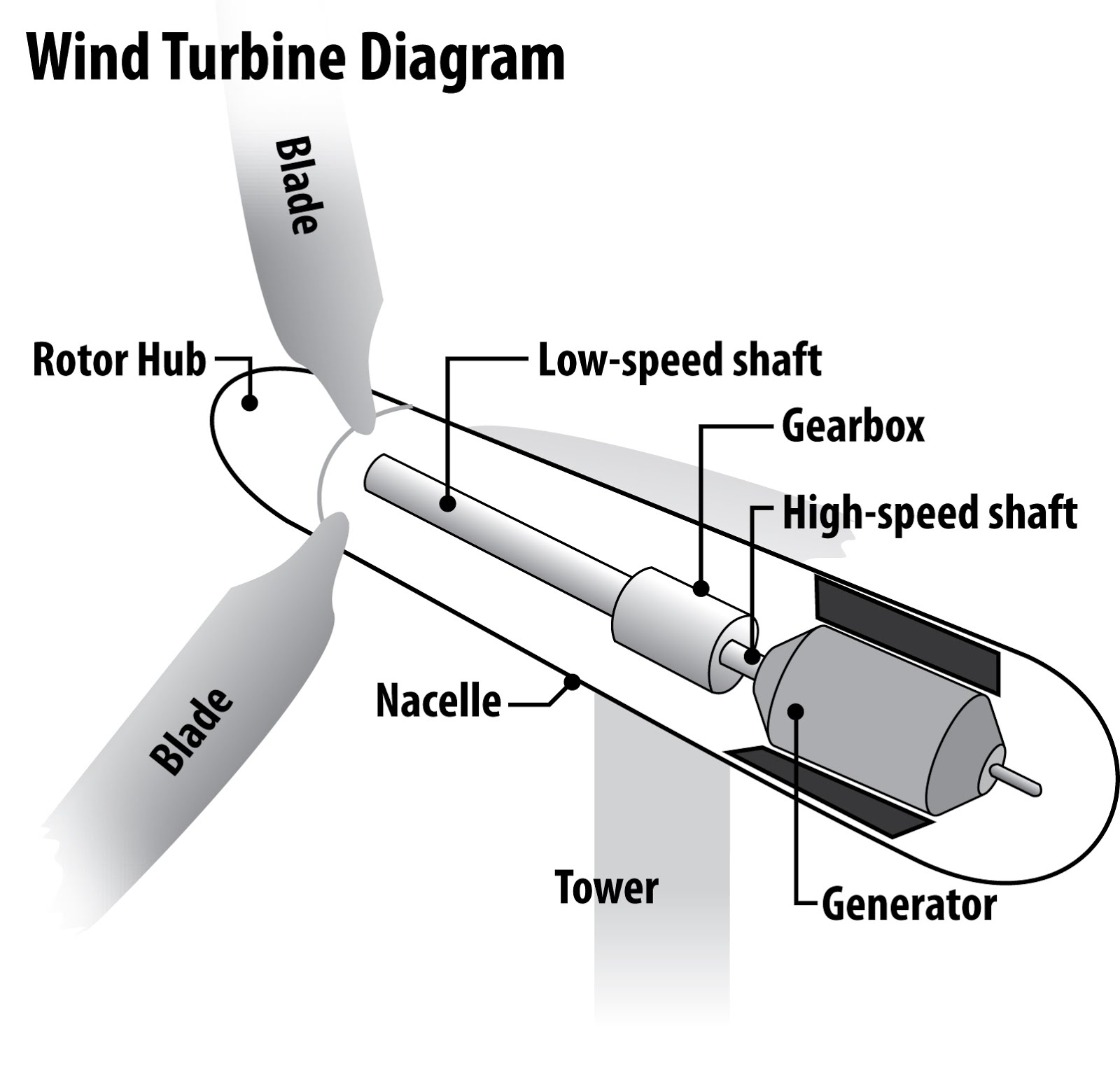
    The technology of using the wind to turn blades on a mill is centuries old, and a similar technology has been developed for the purpose of generating electricity through wind turbines. Before installing a wind turbine, a suitable sitting site must be selected. There are various factors that must be considered, including clear required land area without other structures blocking the flow of air, and ensuring that the area experiences enough wind to generate the maximum amount of energy possible (Clarke S., Rural Environment/OMAFRA, 2003). After the turbine is installed, it can begin collecting the wind’s kinetic energy with the blades of the turbine, mounted on top of a tall tower to take advantage of stronger and more consistent winds, with OMAFRA recommending a height of 24-37 metres. The function of the two or three blades is to gain lift from the motion of the wind, in turn rotating the blades. The rotation continues through the low-speed shaft and gearbox where the speed is optimized, to rotate the generator thus producing electricity. Wind turbines of various sizes are used to power individual homes and farms, or can also be attached to an electric grid system in conjunction with other wind turbines, often in large field where many turbines are placed in one area with some distance between them. Still, innovation continues are people are considering other possibly more efficient ways of producing more energy using wind power, such as a difference in size for larger and smaller-scale use, and using it in conjunction with other renewable sources of energy (Clarke).
Wind Power in Ontario
    In Ontario the amount of wind power produced is monitored on a daily basis as weather conditions change. Depending on the number of megawatts being generated, the ‘Ontario Wind Output’ is essentially enough to meet the needs of an entire city. The province’s power grid has connections to over 1,500 megawatts of wind-generated electricity, a number that is likely to rise with many more wind projects scheduled for the next couple of years (Independent Electricity System Operator, 2013). There are many who support these missions, such as the Canadian Wind Energy Association, which believes that by 2025 wind power can supply 20 per cent of Canada’s electricity (2008). As of 2012, Ontario and British Columbia also are planned to be the first provinces in Canada with offshore wind farms being developed (Canadian Geographic, n.d.).
Advantages and Disadvantages of Wind Turbines
    One advantage of using wind power is that it is a versatile source of energy for a variety of areas. Especially remote areas can benefit from this global force of nature because it can be used independent from other shared sources within larger communities. Still, it can also be used as a shared resource in a network of connections with different facilities and power sources, being equally as useful in a larger scale. Some potential consequences or risks associated with it can be averted by using wind power in combination with other energy sources such as solar power. By combining wind power with other sources of renewable energy, chances of power being inaccessible during unfavourable conditions are are greatly reduced with wind power playing it’s own part in compensating for other sources when conditions are not optimal for production of energy by things such as the sun. According to sources such as the Battelle Pacific Northwest Laboratory and the Canadian Wind Energy Association it is estimated that wind power has the potential to supply up to one fifth of America’s energy demands (Clarke).  The degree of reliability of the wind in areas with more ideal conditions ensures a cleaner source of power with an average availability factor of over 98 per cent, which is higher than most power plants which require maintenance (The American Wind Energy Association, National Renewable Energy Laboratory, U.S. Department of Energy, n.d.).
    Although the convenience of the wind can be an incentive for using wind power, the unreliability of it can also be an issue. Despite being readily available to many areas, just as other conventional methods of producing energy a wind turbine likely will not produce energy all the time. From an economic standpoint, there are some risks associated with using wind turbines as a power source. For a small wind turbine to be cost effective, 14.4-16.2 km per hour winds are necessary as well as enough land which varies depending on the size of the turbine, otherwise the cost of owning a wind turbine may be greater than the monetary benefits.  Most of the coast associated with them are buying the turbine itself --representing 12-48 per cent of the total cost-- and installation. The price of purchase varies depending on it’s size, ranging from $2 thousand to 8 thousand for a small one depending on the kilowatts. Reliability of wind power is often questioned since it’s strength and turbulence varies, and because each turbine has a ‘wind shadow’ behind it where the air flow is interrupted sufficient space must be given between individual turbines (Radford, 2013), though this is comparably small. Finding a suitable sitting area to place such an investment can also be challenging. One factor that is considered when selecting sitting sites is surrounding structures such as trees and buildings that can interfere and limit the flow of air; trees being of special concern because they grow and increase in height over time, whereas turbines do not grow to reach the wind (Clarke).
    Encroaching on natural habitats and interfering with ecosystems is a problem with wind turbines. Not only do some believe wind turbines interrupt beautiful natural scenery, but the bigger issue is the threat it poses local to wildlife. Careful consideration for an area’s wildlife must be made when selecting sitting sites for wind turbines, which are generally extensive in area, as to avoid upsetting the local ecosystem such as invasion or even destruction of natural habitats for a turbine’s required space. Birds and bats are of special concern regarding collisions with the turbines causing injury and horrible deaths. This too, is a debated point, as The Ontario Ministry of Agriculture and Food’s website states that “Wind turbines are not, as many people believe, dangerous to birds. A sliding glass door is more dangerous to birds than a small wind turbine.” (Clarke, wind availability ¶2).  However, sliding glass doors do not extend as high into the air as wind turbines, and would be be even harder for bats to detect at night using echolocation. Although the estimated number of birds killed by wind turbines varies, according to an estimate by the U.S. Fish and Wildlife Services it may be as high as 440,000 per year (American Bird Conservancy, 2010). This is an obvious danger to flying creatures and threat to biodiversity within an ecosystem, because not only will animals suffer the injuries and death, but the rest of the ecosystem will suffer because of this unbalancing factor.‘Bird-smart’ measures must be considered in order to minimize bird deaths because of wind turbines. Especially when sitting areas are high-risk zones in terms of posing a threat to birds, measures that can be taken includes burying transmission lines, and following standards set by the Avian Power Line Interaction Committee has also been recommended by the American Bird Conservancy (2010). Still, various animal species including birds continue to suffer because of greenhouse gas emissions from the combustion of fossil fuels to provide energy, which is also a problem of comparable weight.
    A social and potentially environmental issue with wind turbines is noise pollution. According to OMAFRA, a typical wind turbine can be heard at about 45 decibels from 250 metres away. That sound level is approximately 15 decibels lower than an average conversation which is typically around 60 decibels. It is important that zoning laws and regulations are adhered to when choosing a sitting sites, but also to take into consideration the feelings of neighbours in the area. Many people who live in areas with wind turbines frequently complain about the aerodynamic and mechanical noise generated at all times of day. It is suggested that small, privately-owned turbines are placed at least 250-300 metres away from neighbours (Clarke). It is also possible that this noise may interfere with animals’ abilities to survive, particularly ones that depend on sense of hearing for hunting, eluding predators, or even navigation.
    Despite some social resistance to the use of wind turbines, their potential to help in the social development of more environmentally-conscious communities poses an advantage that will be considered in making global decisions regarding wind power. One aspect of this development is in already-developed countries, regarding the amount of fossil fuels consumed in production and household use. There are individuals who believe that some wars are caused by the greed for oil, and by replacing this depleting commodity with renewable resources such as wind power which can be applied in many different areas, a country becomes less dependant on oil imports. This can improve the environmental, social, and economic state of a country, encouraging a more healthy planet and creating more environmentally-conscious jobs and another possible source of income for those owning wind turbines connected to power grids (Nannette Richford),. The versatile technology of wind power allows it to be used in a variety of places, including in countries that are considered ‘underdeveloped’. Wind power can give countries with available wind resources an industry and source of electricity which does not contribute to the problem of pollution (Abramowski J., Posorski R., 2000). The social advantage of wind power is broad enough that it encompasses reducing carbon emissions from already-industrialized regions, and potentially improving the quality of life in regions where some people may feel they are lacking because of unavailability of fossil fuels.
    The possible dangers associated with the use of wind turbines has motivated some staunch resistance, but the possibility of improvement has also sparked some movement in a world in dire need of renewable energy for environmental, social, and economic reasons. The debate continues over whether or not to utilize this powerful force of nature to generate energy for our own use, but what we do know is that wind power is proving to have a potential place of supplementing other cleaner sources of electricity for vital change to be made for the sake of the Earth and all of it’s inhabitants.


Bibliography
Abramowski, J., & Posorski, R. (2000, February 16). Wind Energy for Developing Countries. DEWI-
German Wind Energy Institute. Retrieved April 10, 2013, from www.dewi.de/dewi/fileadmin/pdf/publications/Magazin_16/06.pdf
American Bird Conservancy. (n.d.). Wind Energy Frequently Asked Questions. American Bird
Conservancy - Home. Retrieved April 3, 2013, from http://www.abcbirds.org/abcprograms/policy/collisions/wind_faq.html
American Wind Energy Association, U.S. Department of Energy, the National Renewable Energy
Laboratory. (n.d.). The Most Frequently Asked Questions about Wind Energy. Home. Retrieved April 8, 2013, from http://www.culturechange.org/wind.htm
BirdLife International. (n.d.). Managing Effects of Wind Power on Birds and Bats | BirdLife
Community. BirdLife International - conserving the world's birds. Retrieved March 26, 2013, from www.birdlife.org/community/2012/10/managing-effects-of-wind-power-on-birds-and-bats/
Canadian Geographic. (n.d.). The Canadian Atlas Online - Wind energy. Canadian Geographic -
Canadian Geographic Magazine. Retrieved April 3, 2013, from http://www.canadiangeographic.ca/atlas/themes.aspx?id=windenergy&sub=windenergy_basics_history
Clarke, S. (n.d.). Electricity Generation Using Small Wind Turbines at Your Home or Farm. Ontario
Ministry of Rural Affairs / Ministry of Agriculture and Food / Ministère des Affaires rurales / ministère de l'Agriculture et de l'Alimentation de l'Ontario. Retrieved March 26, 2013, from http://www.omafra.gov.on.ca/english/engineer/facts/03-047.htm
Independent Electricity System Operator. (n.d.). Wind Power in Ontario. Independent Electricity
System Operator (IESO). Retrieved March 26, 2013, from http://www.ieso.ca/imoweb/marketdata/windpower.asp
Radford, T. (2013, April 9). Wind power 'has inescapable limits'. Climate News Network, n/a.
Retrieved April 8, 2013, from http://www.climatenewsnetwork.net/?s=wind+turbines
Richford, N. (n.d.). Explanation of Wind Turbines | National Geographic. Green Living | National
Geographic. Retrieved October 11, 2013, from http://greenliving.nationalgeographic.com/explanation-wind-turbines-2967.html
U.S. Energy Information Administration (EIA). (n.d.). How much oil does the United States consume
per year? - FAQ - U.S. Energy Information Administration (EIA). Independent Statistics & Analysis U.S. Energy Information Administration (EIA). Retrieved April 3, 2013, from http://www.eia.gov/tools/faqs/faq.cfm?id=33&t=6