Showing posts with label birds. Show all posts

Saturday, 9 December 2023

Waterfowl to Look out for in Southern Ontario This Winter

With the snow coming with the cold weather many nature-lovers are preparing to bundle up and find things to do outdoors.

My personal favourite thing to do over the winter is look for migratory birds passing through. If you're in the Greater Toronto Area, here are a few types of birds to keep an eye open for:


Hooded Merganser (Lophodytes cucullatus)

The hooded merganser is distinct by the dramatic crest of white or copper on its head that can expand or collapse. Like many other birds, this species shows clear sexual dimorphism (where males and females look different), with the females not having the high-contrasting black and white markings that males have. 


Trumpeter Swan (Cygnus buccinator)

A symbol of lifelong love, swans mate for life and easily steal the spotlight amoung other migratory waterfowl. Their long necks, high stature, and striking white colour make them easy to spot. They are often seen in small groups, sometimes with younger swans with darker feathers. Trumpeter swans particularly have all black bills. 


Pied-billed Grebe (Podilymbus podiceps)

These cute little birds are not to be confused with ducks. They have lobed toes that they use to scoot across the water's surface, often bobbing their heads forward as they swim. They are solitary and can also be seen diving, but will not dive as deep as loons will. 

Bufflehead (Bucephala albeola)

Buffleheads are shy towards other species of birds and towards humans. Their shy nature can make them difficult to get close enough to photograph, but they can be easily spotted often in pairs or with their flocks as they migrate. They also show sexual dimorphsm, with females being darker than males.


Canada Goose (Branta canadensis)
During the wintertime this familiar waterfowl can be seen in droves, with hundreds and hundreds flying into bodies of water as they migrate. Known for their aggressive nature, many people have stories of being chased or attacked by the notorious bird, earning it the nickname "cobra chicken".


American coot (Fulica americana)
Rarer in Canada than the United States, the American coot may be spotted with a silhouette like a mallard's in the water, or with a much more distinct shape when it stands. American coots have red eyes and a white bill that extends to their forehead with red on the top.


Long-tailed duck (Clangula hyemalis)

It's not so clear in the photos I was able to get, but the long-tailed duck's name is descriptive of it's most obvious feature on males: long feathers on its tail arching upwards. By contrast, females are brown and white and do not have the long tail.


Mallard (Anas platyrhynchos) 

This common duck lives around the Greater Toronto Area year-round, but can be seen migrating in flocks over the wintertime. Females are neutral brown, while males have green iridescent heads and grey-brown bodies. Shown in the picture on the left is an albino Mallard spotted with a regularly-coloured male companion.

Common Loon (Gavia immer)

Popular with tourists year-round in Algonquin Park, loons can be seen migrating through the Toronto area over the winter months. They will most often be seen solitary, more deeply submerged than mallards, and often diving. 

Monday, 20 January 2014

Keeping an Eye Out: Irruption of Snowy Owls

   As it turns out, it wasn't all chance that in December two members of my family spotted a snowy owl. It was very unusual for this area (I had never seen a wild
one here before), and it looks like I'm a little tardy in finding out why. Right now there is an irruption of snowy owls; while they'd usually stay closer to the Arctic circle, right now a large number of them are migrating farther south than usual, and sigtings have been sightings as far south as South Carolina. Peter Paton, an ornithologist said to the Providence Journal, "An irruption like this probably hasn’t happened in 30 years or more”.
    An irruption has more than one possible cause. One common reason is the fluctuation of lemming populations; since lemmings are the snowy owl's primary food source, when lemming populations are low snowy owls will sometimes go south in search of food. Other times it may be because it was a particularly successful breeding season (even with an abundance of food) so owls spread out a bit more with all the growing youngsters, and weather may also trigger an irruption and have an affect on the dispersion of this nomadic species. Also, if you see a snowy owl is it suggested to observe from a distance, and if it looks at you then that that is a potential warning sign. If you see any injured snowy owls, please contact a local wildlife rehabilitation center.

   An irruption of snowy owls occurs about once every four years in southern Canada and irruptions like this one even less often, more like once every 10-15 years. The ranges are unpredictable, so if you're in southern Ontario or the States, keep an eye out to the skies and on the ground for these beautiful birds while they're here!
   To read December's post about snowy owls, click here. (http://naturenimbus.blogspot.ca/2013/12/snowy-owl.html)


References


Saturday, 21 December 2013

Facts About Snowy Owls

Snowy Owl (Bubo scandiaca)


Field Notes:
Last Saturday a fairly large circle of migrating cackling geese were sitting in a circle around a lone white bird in the center on a frozen local lake. To our delight, the zoom on the camera revealed that it was a snowy owl! The bird had dark spots and appeared to be a young female. She sat on the lake huddled in her feathers surrounded by the geese that sat formally encircling her. 

Within just a couple minutes most of the geese on the lake had flown away, leaving the snowy owl alone. She silently floated over the ice and turning her head to peer at us from afar. Despite being in the middle of a frozen lake she seemed shy so we used the zoom on the camera to look from a distance. Snowy owls are not a common sight here in Ontario, but just a couple days before my father had seen in the neighborhood, flying silently, almost as if it was floating in the air. It was a very rare and exciting sighting in this area, and hopefully she has a good journey!

About Snowy Owls
The majestic snowy owl is a rare winter visitor in Ontario, living mainly in the the Arctic Tundra, father North than any other North American owl. They are large, white owls with some dark flecks (which is good for camouflaging) and yellow cat-like eyes that take up more space in the skull than its brain. Their feathers (also covering their powerful talons) keeps them warm in their cold habitat, as well chick's grey down feathers. Males are smaller and paler with small dark spots, whereas females are significantly larger with darker horizontal grey-brown lines. In both cases, younger adults adults ones have darker markings that pale with age, some older males being pure white.
Size: 51-69cm L


Unlike many other owls, snowy owls are largely diurnal, hunting during the day. These large, silent fliers will often sit perched somewhere high up out in the open, where (s)he can get a bird's-eye view and listen for prey. Snowy Owls prey mainly on lemmings, as well as ptarmigans, voles, and other small animals, coughing up undigested parts such as fur and bones in pellets. An adult will take prey back to the nest if it is breeding season. Parents tear up pieces of meat for the chicks while they are young, and when the owlets are older they swallow prey whole. When lemming and vole populations severely decrease, snowy owls may move south in search of food.

Snowy owls are sexually mature at 3-5 years old, and are generally monogamous. Clutches are laid in nests on the ground in the middle of the open Tundra with up to 12 eggs at one time when food is abundant, although when food is scare they may not breed for a year. The incubation period is 30-33 days, where the older eggs may be laid and hatched two or three days before the youngest.

Snowy owls are also territorial and tend to be aggressive when defending their territory or their young. Despite being typically silent, they may be vocally aggressive with a raspy call or a shriek if it is a female. They may be physically aggressive if a potential predator (such as a fox, human, or even a wolf) gets too close to the nest and threatens their young. Unfortunately their population is one a decreasing trend, one cause being hunting, but their their conservation status on the IUCN redlist as of December 21, 2013 is least concern.

References
T, Travis. 2001. Snowy Owl. Blue Planet Biomes. Retrieved from http://www.blueplanetbiomes.org/snowy_owl.htm.


IUCN 2013. IUCN Red List of Threatened Species. Version 2013.2. <www.iucnredlist.org>. Downloaded on 21 December 2013.

Parmelee, David F. 1992. Snowy Owl (Bubo scandiacus), The Birds of North America Online (A. Poole, Ed.). Ithaca: Cornell Lab of Ornithology; Retrieved from the Birds of North America Online:http://bna.birds.cornell.edu/bna/species/010

Tuesday, 17 December 2013

The Real Costs of Parathion


     The conflict of human convenience and the wellbeing of ecosystems is a repeating issue. Parathion (usually  referring to ethyl parathion, sometimes methyl parathion), is an effective insecticide and one of the most toxic organphosphates, proved to be sometimes fatal to humans and other animals. The original intent for producing and using parathion as an insecticide are not malicious, however with more recent information the risks have become more apparent. The convenience of using parathion is not worth the consequences to natural ecosystems and human health.
An Effective Method
     Parathion is an effective and relatively cheap insecticide. It kills unwanted insect 'pests' by disrupting their nerve impulses. Pest control has played a large role in farming and the mass production of food to feed millions of people, and is also part of the monetary success for individual farmers and overall economies. Pesticides are especially needed for monocultures of food that resulted from the Green Revolution of mass factory farming, as an entire culture would be susceptible to unwanted insects. The method of factory farming has helped humans avoid Thomas Malthus' prediction that starvation would overtake the world by the year 2000, however, the use of pesticides is among the many rising issues associated with factory farming, and there are safer options than parathion such as introducing a natural predator or genetically modifying crops so that they are less susceptible to the pest. Many organic farmers have successfully raised crops without the use of any pesticides, as all pesticides do have the potential for adverse side effects. One of the reasons parathion is used is because its high toxicity makes it highly effective, but it also highly effective on other non-targeted species.

A Toxic Threat
     Other living things are not immune to the devastating effects parathion has on an organism, Parathion has proven to be especially toxic to birds such as grouse, pigeons, red-winged blackbirds, and sparrows. Amounts of dermal exposure may be fatal for birds such as house sparrows, which have 50% mortality rate after 24 hours of dermal exposure of 1.8 mg / kg on their feet. Not only do they receive exposure through the air when it is sprayed, but also because of what they prey on. Ethyl parathion has been pinned as the direct cause of death for birds in numerous instances, for example the death of fourteen Mississippi kites from insects that were contaminated by parathion in a nearby cotton field in 1994. Another occurrence was in 1982, New York, when almost 3200 birds of various species were found dead in a field containing scattered rye seeds contaminated with ethyl parathion. As birds consume contaminated seeds and insects, bioaccumulation and biomagnification occur and the buildup of parathion in their systems often kills them, and can also impair some birds exposed to nonlethal doses in terms of ability to avert predators, and reproductive behavior (such as with the mallard and bobwhite) though it is unknown whether or not parathion affects reproductive ability.
     Parathion also has the potential to damage ecosystems by damaging other wildlife. Damage to aquatic invertebrates with ethyl parathion occurs with an EC50 at less than 1.0mg/L. On an acute basis it is also toxic to fish, with the potential to throw off the delicate balance of many aquatic ecosystems with water contamination. This would have a negative impact on entire ecosystems and communities whose economies and jobs depend on the fishing industry. Honeybees also play important roles in their ecosystems as pollinators, and they too are highly susceptible to the toxicity of parathion. Pollinators are necessary for growing plants in both natural ecosystems and in growing crops for humans in farms.
     Humans are also vulnerable to the health hazards of parathion, especially those who work with the chemical or live near landfills where it is disposed of. Parathion is a carcinogen and endocrine disruptor, and has been reported to have cause an influenza-like state and has also been associated with indirect brain impairments, such as disorientation, memory loss, decreased ability to concentrate, confusion, and delayed reflexes. It has also been linked with emotional disorders such as severe depression and insomnia. Nerve damage occurs because parathion is a cholinesterase-inhibiting chemical, which prevents the breakdown of acetylcholine when it is no longer needed to trigger physical reponses to nerve impulses. The buildup of acetylcholine causes the impulses to be repeated uncontrollably, with potential direct symptoms such as muscle spasms, trembling, paralyzed breathing, irregular heartbeat, convulsions, involuntary bowel movement, and in the most extreme cases, coma or even death.

     Considering evidence proving a direct link between various adverse effects parathion has on the health of other animals such as birds, aquatic invertebrates, fish, pollinating insects, and humans, the risks are obvious and severe. The potentially risks outweigh the benefits of convenience as the real cost goes beyond monetary values, but takes a toll on health of natural ecosystems, humans and other animals.

Sources
Bird Conservancy. (n.d.). Pesticide Profile - Ethyl parathion. abc birds. Retrieved December 12, 2013, from http://www.abcbirds.org/abcprograms/policy/toxins/profiles/ethyl_parathion.html

EXTOXNET. (n.d.). Cholinesterase Inhibition. EXTOXNET. Retrieved December 12, 2013, from http://extoxnet.orst.edu/tibs/cholines.htm

The Encyclopedia of Earth. (2008, August 1). Health effects of methyl parathion Edit Classification Publishing Workflow . The Encyclopedia of Earth. Retrieved December 12, 2013, from http://www.eoearth.org/view/article/153408/

Pesticide Information Center. (n.d.). Parathion. EXTOXNET. Retrieved December 12, 2013, from http://extoxnet.orst.edu/pips/parathio.htm Reuber, M., & Cooper, S. (n.d.). PARATHION (Ethyl parathion). Beyond Pesticides. Retrieved December 12, 2013, from http://www.beyondpesticides.org/pesticides/factsheets/parathion.pdf

Tuesday, 3 December 2013

Local Bird: Cedar Waxwing

Cedar Waxwing (Bombycilla cedrorum)


Physical characteristics: 
     Cedar waxwings have very slick, smooth look with a gradient brown or orange to yellow body. A few red spots stand out on grey wings, and, and with yellow terminal tail band (the tips of the tail feathers is yellow)on a grey tail with a white undertail. The cedar waxwing has a crest and a black mask and beak, giving it a "heroic" look. The cedar waxwing is about has a 30cm wingspan and the ones I have seen are about the size of a robin.

Habitat/range: Wooded areas and fields throughout Ontario during the breeding season.

     Cedar waxwings are very social birds and are often seen in flocks, especially around areas with fermenting berries to feast on. During migration they may even be seen in flocks of hundreds or occasionally even thousands. They might be seen lined up, passing down berries to share until an individual decides to eat it, and then another berry is picked to be passed down the line again. This endearing behaviour is also seen in a cute courtship dance where the male will hop towards the female, offering her a berry. After accepting the berry, she hops a little way with it before stopping to hop towards him again to offer it back to him, and the dance repeats.
     They build nests out of twigs, lichen, and moss in both coniferous and deciduous trees and shrubs. A female lays 3-5 eggs at a time, with an incubation period of 12-16 days. The cedar waxwing's call is high, lisping, and trilling.

Distinguishing a Bohemian Waxwing (Bombycilla garrulus) from a Cedar Waxwing:
They have a  similar appearance, but are distinguishable by both physical traits and range during certain times of year.
  • Bohemian Waxwings have a grey chest and belly, and red-orange undertail.
  • Bohemian waxwings are slightly larger.
  • During breeding season bohemian waxwings live in Northern Canada, Alaska, and high Northwestern American mountains. Unless you live in one of those regions, if it is Summer, spring or early fall then it is a Cedar Waxwing.
Field notes:
     This summer I got to see two cedar waxwings within two days of eachother. This might be due to the fact that they are often in flocks so although at the time they were both alone (once perched on a tall branch and once sitting in a mulberry berry tree), the rest of the flock might have just dispersed somewhere nearby.
    The two cedar waxwings also had different appearances. The first one was in a tree by a lake with a gregarious set of more intense colours and posture (the orange was very clear), whereas the other had slightly more neutral colours (a paler yellow and more mousy brown than orange head), with a more mysterious and intriguing beauty. Its appearance was especially similar to a bohemian waxwing's in the shade, however the undertail was white and it was summer in Ontario so it was indeed a cedar waxwing.


References
Bezener, A., Kagume, K., Kennedy, G., & Adams, C. (2005). Compact Guide to Ontario Birds. 
     Edmonton: Lone Pine Pub.
"Corey". (n.d.). Cedar Waxwing vs. Bohemian Waxwing. 10,000 Birds. Retrieved December 3, 
     2013, from http://10000birds.com/cedar-waxwing-vs-bohemian-waxwing.htm 
Kagume, K., Kershaw, L. J., & Bezener, A. (2008). Ontario nature guide. Edmonton: Lone Pine.
Cornell Lab of Ornithology. (n.d.). Cedar Waxwing. All About Birds. Retrieved December 1, 2013, 
National Geographic. 2006. Cedar Waxwing. http://animals.nationalgeographic.com/animals/birding/cedar-waxwing?source=A-to-Z

Thursday, 28 November 2013

How do geese keep their feet warm in the winter?

     While watching the migrating geese resting on a lake with a coat and hat and gloves on and still feeling chilly, it's amazing to see the birds swimming atop the icy waters. Sometimes I imagine being a goose, duck, or swan migrating during the winter. Unlike some birds that seek shelter from the elements, they remain on the water. Although they have waterproof feathers atop down feathers to keep their bodies warm, their feet are still exposed to the icy waters yet they are not frozen.
     The key lies in counter-current heat exchange. In the legs of ducks, geese, and other types of birds, the arteries (blood flowing away from the heart) have branches that are very close to branched veins (blood flowing towards the heart), allowing the warmer blood flowing towards the feet to cool, and warming up the blood coming up from the feet. This way, the foot is kept colder; without the branched blood vessels, the blood that reaches the foot is still warm.
     At first it might not seem to answer the question, as it seems to be that they keep their feet warm by making their feet cold? Well, the point is not to keep their feet warm, but it is to make them colder so that the heat needed in other parts of the body is not lost. This works because body heat is lost when the outside environment is colder than the exposed tissue, so the less the different in temperature in a goose's exposed feet with the water, the less body heat will be lost. To reduce the amount of heat lost, they also reduce their surface contact with ice which (according to askanaturalist.com) is the reason why you might see them balancing on one foot at a time. 
     Heat exchange also prevents cold blood from cooling down the parts of the body covered by feathers as the blood flows back towards the heart in the veins.
     This heat exchange is also applied when a bird is in a very hot environment, as it keeps it from overheating, as well as with other animals such as marine mammals, which have a net of branched veins and arteries around their bodies below their skin to protect them from the cold in addition to fat insulation.

Sources
AskANaturalist.com. Why Don't Ducks' Feet Freeze? Ask A Naturalist. Retrieved from http://askanaturalist.com/why-don%E2%80%99t-ducks%E2%80%99-feet-freeze/
Eccentricscheinstist.wordpress.com. Why Don't ducks get Frostbite? Wordpress. Retrieved from  http://eccentricscientist.wordpress.com/2007/01/13/why-dont-ducks-get-frostbite/

Friday, 22 November 2013

About a Bustard -Kori Bustard (Ardotis kori)

Kori Bustard (Ardotis kori)

(photo coming soon)

Conservation Status: Least Concern

Habitat: South and Eastern African grasslands and wooded areas

Physical characteristics: Long neck grey neck and head, long beak,  As a species, the kori bustard is the world's heaviest flying bird, the males weighing up to about 18 kg (39.6 lbs). They display sexual dimorphism, as males may weigh up to twice the weight of females, though they have similar plumage.

Lifespan: The longest recorded lifespan is 26 years in captivity, and there is approximately 86% mortality rate amoungst chicks in the wild.

Notes:
     One of 25 species of bustard, like other bustard species the kori kustard does not typically engage well with humans and will shy away from human contact. Generally they remain silent, however if alarmed they will make a loud barking sound, as well as displaying a "shock display" where the bird bends forward with its tail feathers lifted and spreading out its wings to appear larger than its actual size to predators.
     Their omnivorous diet consists largely of insects, however they also sometimes feed on smaller vertebrates such as lizards, snakes, birds, and small mammals. They also eat fruits including berries (and Tsamma Melons, see "What animals (besides humans) eat watermelons and pumpkins?" post), as well as nuts and Acacia tree gum (hence its alternate name Gompou' which means "gum eating"). They also have the rare habit of sucking up water when drinking. Its predators include eagles, lions, and jackals. Carine bee-eaters (Merops nubicus and Merops nubicodes) will sometimes perch on the back of an active kori bustard and eat the bugs disturbed by the bustard's activity, and may help the bustard detect predators.
     In courtship, the male will inflate his esophagus (up to a peak of four times its regular size), point his crest up and his wing and tail feathers down, and make a low booming noise to attract a female. Males will often perform this together in a group. The rearing of chicks is up to the mother, whose nest is a scrape in the ground with an in-captivity incubation period of 23 days.

Sources
Smithsonian National Zoological Park

Arkive.org.

Tuesday, 30 April 2013

Samoa's Endangered Manumea & Mao


   Samoa is a cluster of ten tropical islands, home to a wide variety of species including the little dodo and giant honeyeater. Surveys of Samoa’s tropical forests indicate that quick action must be taken to save the little dodo from the same fate as it’s extinct cousin. The locals describe the little dodo (also called Manumea) as the princess of the forest, and are worried about the distinct ground pigeon’s future. Biologist Rebecca Stirnemann reports seeing only ten in the wild in two and a half years of fieldwork, and says, “Surveys suggest that less than 200 birds remain, but the actual population size maybe much lower than this.” One of the primary concerns is that birds are being killed in their nests by invasive rats which are non-native to Samoa’s forests, the little dodo’s only habitat. There are none of it’s kind in captivity which makes conservation efforts all the more crucial to save the species from it’s fall to extinction, and captive breeding may be a next step.
   Sadly, the little dodo is not Samoa’s only endangered bird, as it stands by the Maomao (also called honeyeater or “Mao”) on the IUCN Red List. Their relatively slow rate of reproduction compounds the species’ risk of predation, and time on the forest floor makes them very vulnerable to predators. To conserve both species that live scattered on Samoa's ten islands, conservationists and biologists like Stirnemann are looking to work with the local people in Samoa through education and direct conservation of the 76% of the land owned by them, to protect the birds they share adoration for. Research is also being done to determine the most effective actions to take such as potential rat control in areas where the birds are most vulnerable.

References
Callaway, E., & Outcalt, J. (2012, March 2). » Save the Biodiversity of Samoa. Birdfreak.com - Birds, Conservation, & the Great Outdoors. Retrieved April 29, 2013, from http://birdfreak.com/save-the-biodiversity-of-samoa/
Hance, J. (2013, March 4). Extinction warning: racing to save the little dodo from its cousin's fate.Monga Bay conservation news and environmental science news. Retrieved April 30, 2013, from http://news.mongabay.com/2013/0304-hance-little-dodo.html

Save the biodiversity of Samoa. (n.d.). The Mao and Manumea project. Save the biodiversity of Samoa. Retrieved April 30, 2013, from http://samoanbirds.com/

Friday, 12 April 2013

Harnessing Wind Power

Harnessing Wind Power
Melody Tadeo
April 12, 2013
Mr. Wood
     For generations humans have harnessed the power of the wind for various uses including transportation and a power source for processing resources in a windmill . Today, wind turbines are being used to provide roughly 1 per cent of Earth’s energy, being a source that is both renewable and highly controversial. The benefits and disadvantages of using this force to produce energy include benefits and damage to ecosystems, economic gain and risk, and social acceptance, with changing consideration as conditions change.
The Need for Cleaner Energy
    What is generally considered the foremost important reason to use wind turbines to generate electricity is that it is a renewable resource. To generate electricity through turbines, after production there are zero pollutants emitted into the atmosphere (Nannette Richford, n.d.). With a growing need for alternative fuel sources, ‘clean energy’ that cause less harm to the environment through emission of pollutants and damage to natural ecosystems, wind power has become a well-known alternative that requires no fossil fuels to generate electricity. The depletion of is of great concern to people in nations around the world, and the need for renewable sources of energy grows with every barrel of oil extracted from the Earth. In 2010 America consumed about about 7 billion barrels of refined petroleum products and biofuels (U.S. Energy Information Administration, 2012), and about 19 per cent of the world’s energy is already provided by renewable sources, a number that is likely to continue to rise (BirdLife International, 2012). With more and more evidence suggesting damage to the environment because of pollutants —including man-made climate change— it becomes more and more clear that the human race must reduce emission of pollutants, and modify energy sources to meet a mandatory standard to minimize the consequences.
Wind Power Technology
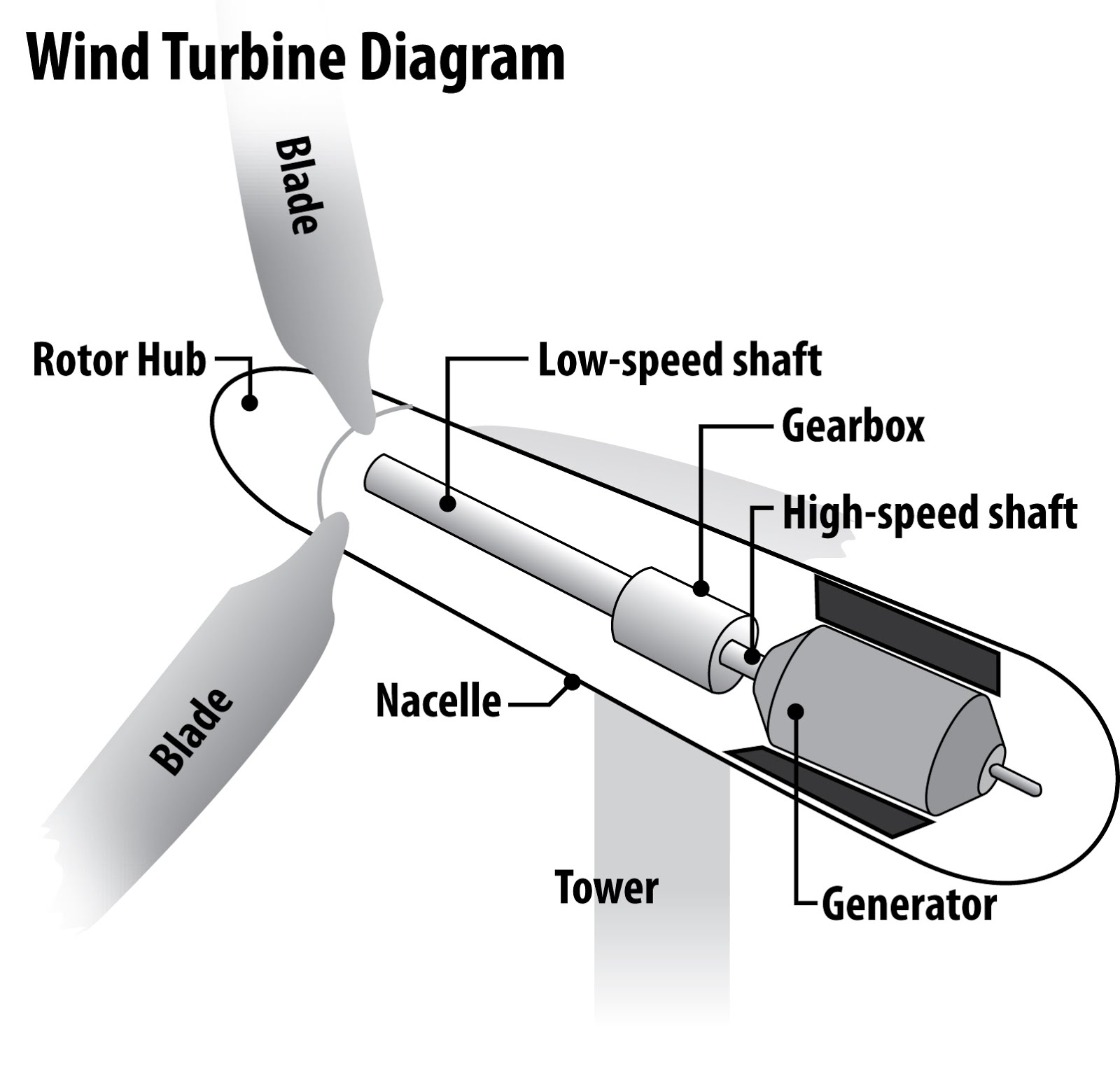
    The technology of using the wind to turn blades on a mill is centuries old, and a similar technology has been developed for the purpose of generating electricity through wind turbines. Before installing a wind turbine, a suitable sitting site must be selected. There are various factors that must be considered, including clear required land area without other structures blocking the flow of air, and ensuring that the area experiences enough wind to generate the maximum amount of energy possible (Clarke S., Rural Environment/OMAFRA, 2003). After the turbine is installed, it can begin collecting the wind’s kinetic energy with the blades of the turbine, mounted on top of a tall tower to take advantage of stronger and more consistent winds, with OMAFRA recommending a height of 24-37 metres. The function of the two or three blades is to gain lift from the motion of the wind, in turn rotating the blades. The rotation continues through the low-speed shaft and gearbox where the speed is optimized, to rotate the generator thus producing electricity. Wind turbines of various sizes are used to power individual homes and farms, or can also be attached to an electric grid system in conjunction with other wind turbines, often in large field where many turbines are placed in one area with some distance between them. Still, innovation continues are people are considering other possibly more efficient ways of producing more energy using wind power, such as a difference in size for larger and smaller-scale use, and using it in conjunction with other renewable sources of energy (Clarke).
Wind Power in Ontario
    In Ontario the amount of wind power produced is monitored on a daily basis as weather conditions change. Depending on the number of megawatts being generated, the ‘Ontario Wind Output’ is essentially enough to meet the needs of an entire city. The province’s power grid has connections to over 1,500 megawatts of wind-generated electricity, a number that is likely to rise with many more wind projects scheduled for the next couple of years (Independent Electricity System Operator, 2013). There are many who support these missions, such as the Canadian Wind Energy Association, which believes that by 2025 wind power can supply 20 per cent of Canada’s electricity (2008). As of 2012, Ontario and British Columbia also are planned to be the first provinces in Canada with offshore wind farms being developed (Canadian Geographic, n.d.).
Advantages and Disadvantages of Wind Turbines
    One advantage of using wind power is that it is a versatile source of energy for a variety of areas. Especially remote areas can benefit from this global force of nature because it can be used independent from other shared sources within larger communities. Still, it can also be used as a shared resource in a network of connections with different facilities and power sources, being equally as useful in a larger scale. Some potential consequences or risks associated with it can be averted by using wind power in combination with other energy sources such as solar power. By combining wind power with other sources of renewable energy, chances of power being inaccessible during unfavourable conditions are are greatly reduced with wind power playing it’s own part in compensating for other sources when conditions are not optimal for production of energy by things such as the sun. According to sources such as the Battelle Pacific Northwest Laboratory and the Canadian Wind Energy Association it is estimated that wind power has the potential to supply up to one fifth of America’s energy demands (Clarke).  The degree of reliability of the wind in areas with more ideal conditions ensures a cleaner source of power with an average availability factor of over 98 per cent, which is higher than most power plants which require maintenance (The American Wind Energy Association, National Renewable Energy Laboratory, U.S. Department of Energy, n.d.).
    Although the convenience of the wind can be an incentive for using wind power, the unreliability of it can also be an issue. Despite being readily available to many areas, just as other conventional methods of producing energy a wind turbine likely will not produce energy all the time. From an economic standpoint, there are some risks associated with using wind turbines as a power source. For a small wind turbine to be cost effective, 14.4-16.2 km per hour winds are necessary as well as enough land which varies depending on the size of the turbine, otherwise the cost of owning a wind turbine may be greater than the monetary benefits.  Most of the coast associated with them are buying the turbine itself --representing 12-48 per cent of the total cost-- and installation. The price of purchase varies depending on it’s size, ranging from $2 thousand to 8 thousand for a small one depending on the kilowatts. Reliability of wind power is often questioned since it’s strength and turbulence varies, and because each turbine has a ‘wind shadow’ behind it where the air flow is interrupted sufficient space must be given between individual turbines (Radford, 2013), though this is comparably small. Finding a suitable sitting area to place such an investment can also be challenging. One factor that is considered when selecting sitting sites is surrounding structures such as trees and buildings that can interfere and limit the flow of air; trees being of special concern because they grow and increase in height over time, whereas turbines do not grow to reach the wind (Clarke).
    Encroaching on natural habitats and interfering with ecosystems is a problem with wind turbines. Not only do some believe wind turbines interrupt beautiful natural scenery, but the bigger issue is the threat it poses local to wildlife. Careful consideration for an area’s wildlife must be made when selecting sitting sites for wind turbines, which are generally extensive in area, as to avoid upsetting the local ecosystem such as invasion or even destruction of natural habitats for a turbine’s required space. Birds and bats are of special concern regarding collisions with the turbines causing injury and horrible deaths. This too, is a debated point, as The Ontario Ministry of Agriculture and Food’s website states that “Wind turbines are not, as many people believe, dangerous to birds. A sliding glass door is more dangerous to birds than a small wind turbine.” (Clarke, wind availability ¶2).  However, sliding glass doors do not extend as high into the air as wind turbines, and would be be even harder for bats to detect at night using echolocation. Although the estimated number of birds killed by wind turbines varies, according to an estimate by the U.S. Fish and Wildlife Services it may be as high as 440,000 per year (American Bird Conservancy, 2010). This is an obvious danger to flying creatures and threat to biodiversity within an ecosystem, because not only will animals suffer the injuries and death, but the rest of the ecosystem will suffer because of this unbalancing factor.‘Bird-smart’ measures must be considered in order to minimize bird deaths because of wind turbines. Especially when sitting areas are high-risk zones in terms of posing a threat to birds, measures that can be taken includes burying transmission lines, and following standards set by the Avian Power Line Interaction Committee has also been recommended by the American Bird Conservancy (2010). Still, various animal species including birds continue to suffer because of greenhouse gas emissions from the combustion of fossil fuels to provide energy, which is also a problem of comparable weight.
    A social and potentially environmental issue with wind turbines is noise pollution. According to OMAFRA, a typical wind turbine can be heard at about 45 decibels from 250 metres away. That sound level is approximately 15 decibels lower than an average conversation which is typically around 60 decibels. It is important that zoning laws and regulations are adhered to when choosing a sitting sites, but also to take into consideration the feelings of neighbours in the area. Many people who live in areas with wind turbines frequently complain about the aerodynamic and mechanical noise generated at all times of day. It is suggested that small, privately-owned turbines are placed at least 250-300 metres away from neighbours (Clarke). It is also possible that this noise may interfere with animals’ abilities to survive, particularly ones that depend on sense of hearing for hunting, eluding predators, or even navigation.
    Despite some social resistance to the use of wind turbines, their potential to help in the social development of more environmentally-conscious communities poses an advantage that will be considered in making global decisions regarding wind power. One aspect of this development is in already-developed countries, regarding the amount of fossil fuels consumed in production and household use. There are individuals who believe that some wars are caused by the greed for oil, and by replacing this depleting commodity with renewable resources such as wind power which can be applied in many different areas, a country becomes less dependant on oil imports. This can improve the environmental, social, and economic state of a country, encouraging a more healthy planet and creating more environmentally-conscious jobs and another possible source of income for those owning wind turbines connected to power grids (Nannette Richford),. The versatile technology of wind power allows it to be used in a variety of places, including in countries that are considered ‘underdeveloped’. Wind power can give countries with available wind resources an industry and source of electricity which does not contribute to the problem of pollution (Abramowski J., Posorski R., 2000). The social advantage of wind power is broad enough that it encompasses reducing carbon emissions from already-industrialized regions, and potentially improving the quality of life in regions where some people may feel they are lacking because of unavailability of fossil fuels.
    The possible dangers associated with the use of wind turbines has motivated some staunch resistance, but the possibility of improvement has also sparked some movement in a world in dire need of renewable energy for environmental, social, and economic reasons. The debate continues over whether or not to utilize this powerful force of nature to generate energy for our own use, but what we do know is that wind power is proving to have a potential place of supplementing other cleaner sources of electricity for vital change to be made for the sake of the Earth and all of it’s inhabitants.


Bibliography
Abramowski, J., & Posorski, R. (2000, February 16). Wind Energy for Developing Countries. DEWI-
German Wind Energy Institute. Retrieved April 10, 2013, from www.dewi.de/dewi/fileadmin/pdf/publications/Magazin_16/06.pdf
American Bird Conservancy. (n.d.). Wind Energy Frequently Asked Questions. American Bird
Conservancy - Home. Retrieved April 3, 2013, from http://www.abcbirds.org/abcprograms/policy/collisions/wind_faq.html
American Wind Energy Association, U.S. Department of Energy, the National Renewable Energy
Laboratory. (n.d.). The Most Frequently Asked Questions about Wind Energy. Home. Retrieved April 8, 2013, from http://www.culturechange.org/wind.htm
BirdLife International. (n.d.). Managing Effects of Wind Power on Birds and Bats | BirdLife
Community. BirdLife International - conserving the world's birds. Retrieved March 26, 2013, from www.birdlife.org/community/2012/10/managing-effects-of-wind-power-on-birds-and-bats/
Canadian Geographic. (n.d.). The Canadian Atlas Online - Wind energy. Canadian Geographic -
Canadian Geographic Magazine. Retrieved April 3, 2013, from http://www.canadiangeographic.ca/atlas/themes.aspx?id=windenergy&sub=windenergy_basics_history
Clarke, S. (n.d.). Electricity Generation Using Small Wind Turbines at Your Home or Farm. Ontario
Ministry of Rural Affairs / Ministry of Agriculture and Food / Ministère des Affaires rurales / ministère de l'Agriculture et de l'Alimentation de l'Ontario. Retrieved March 26, 2013, from http://www.omafra.gov.on.ca/english/engineer/facts/03-047.htm
Independent Electricity System Operator. (n.d.). Wind Power in Ontario. Independent Electricity
System Operator (IESO). Retrieved March 26, 2013, from http://www.ieso.ca/imoweb/marketdata/windpower.asp
Radford, T. (2013, April 9). Wind power 'has inescapable limits'. Climate News Network, n/a.
Retrieved April 8, 2013, from http://www.climatenewsnetwork.net/?s=wind+turbines
Richford, N. (n.d.). Explanation of Wind Turbines | National Geographic. Green Living | National
Geographic. Retrieved October 11, 2013, from http://greenliving.nationalgeographic.com/explanation-wind-turbines-2967.html
U.S. Energy Information Administration (EIA). (n.d.). How much oil does the United States consume
per year? - FAQ - U.S. Energy Information Administration (EIA). Independent Statistics & Analysis U.S. Energy Information Administration (EIA). Retrieved April 3, 2013, from http://www.eia.gov/tools/faqs/faq.cfm?id=33&t=6