Showing posts with label mice. Show all posts

Wednesday, 20 November 2013

What animals (besides humans) eat watermelons and pumpkins?

     Considering their hard, thick exterior, it takes a level of skill to eat a pumpkin or melon.
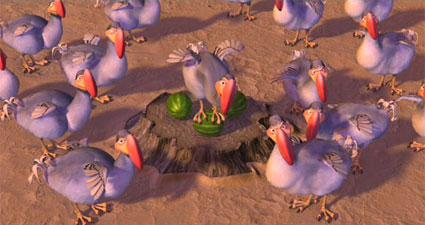
(Ice Age, image source: animatedviews.com)
     Tsamma Melons, a relative to watermelons you would find the the grocery store, grow wild in the Kalahari desert is South Africa. Storing large amounts of water and resistant to drought, they are a good water source as well as food source for animals living in the region, including humans and kori bustards.
     If you grow watermelons in a garden in North America you might end up sharing them with some wild neighbours. Raccoons, deer, coyotes, and especially crows are all animals that might eat a watermelon if they found one.
     Despite being at the top of the food chain, coyotes also will eat watermelon. At night a coyote might sneak into a garden where it will break open a watermelon and eat the flesh right down to the rind. 
     The coyote's distinctive destruction to the fruit contrasts with the method which raccoons and deer eat watermelons. They will dig or puncture a hole through the skin to get to the inside.

     Pumpkins, too, are a reason for wildlife visitors in some gardens. Rabbits only eat the leaves (not the fruit itself), nibbling at the tips, similar to it's habitual sampling of leafy greens. 
     Using their digging abilities, mice and moles get to the seeds inside pumpkins by digging a tunnel through the bottom and into the middle. Squirrels, and chipmunks may also dig through a pumpkin in pursuit of the delicious seeds that await inside, sometimes even being found digging through pumpkins left of porches. Unlike the others, woodchucks eat the actual flesh of the fruit.

Sources
Bauer, Mary. What wild Animals eat Watermelons in a Garden? 
Kane, Dan. Tsamma Melons: Watermelon's Wild Cousins.

Monday, 1 April 2013

The Air of Mice and Men


A study published in Environmental Health Perspectives showed that baby mice exposed to concentrated, real urban air particles were more impulsive later than ones that were not. The mice were trained that to receive a sugary reward they could either press a lever 25 times, or wait for one to be released (called "delay discounting"). However, the releasing  interval were irregular and if a mouse pressed the lever, the waiting time would be reset. The ones that breathed in the pollution particles at four-days-old reset the system up to 43% more times by pressing the lever instead of patiently waiting. This number exhibits how those exposed to urban air pollution in the developing stages of life show more impulsive behaviour for self-gratification, and less patience as adults than ones not exposed to the tiny pollution particles. Such impulsive behaviour has been linked with cognitive and behavioral disorders such as ADHD and substance abuse, strongly suggesting a link between exposure to pollution during the developing stages of the brain and behavioural effects later on in life. Other dangers of ultrafine pollution particles from sources such as cars and factory production include damage to the lungs, heart, and brain, which are being made more evident through studies like this.
Polluted air is bad for not only lungs, but also the minds of people and other animals all sharing the same air and must suffer because of mankind's mistakes. The article did not mention other health effects these poor mice experienced from breathing in man-made pollutants, though asthma was included in damage to the lungs and I wonder if that affected them too. I believe that it is no coincidence that while society advances in technology, sometimes leaving appreciation for nature behind, psychological disorders are becoming more of a problem.
This report brings back the statistic that in one year, 100% of Ontario university graduates in therapy found a job within six months of graduating, displaying the great need for mental health professionals. 
In his book Last Child in the Woods, Richard Louv writes, “Reducing the [nature] deficit...is in our self interest, not only because aesthetics or justice demands it, but also because our mental, physical, and spiritual health depends upon it. The health of the earth is at stake as well.” Combined observations and evidence strengthens my conviction that an appreciation is also important for developing minds —and throughout one's entire life— both chemically and psychologically. This is the very air of the planet that we are poisoning, and no temporary conveniences can be worth that price! By being more aware of the way our actions affect the environment and other living things, more knowledge will no doubt lead to healthier decisions.


Bibliography
Butt, C. (2013, February 27). Baby mice exposed to air particles seek instant rewards, a behavior
linked to addiction. — Environmental Health News. Environmental Health News: Front Page. Retrieved March 12, 2013, from http://www.environmentalhealthnews.org/ehs/newscience/2012/10/2013-0121-mice-ultrafine-particles-impulsive-behavior/
Louv, R. (2005). Introduction. Last child in the woods: saving our children from nature-deficit
disorder (Updated and Expanded ed., p. 3). Chapel Hill, NC: Algonquin Books of Chapel Hill.