Showing posts with label invasive species. Show all posts

Monday, 3 June 2019

Removing Invasives and Making Garlic Mustard Pesto

It's high in Vitamin A and C, and has a potent flavor. (And it indeed has a garlicy flavour).

A common invasive species that can be found in Ontario is garlic mustard (Alliaria petiolata). It is native to Europe, and as the name suggests  is classified a type of mustard and has a garlic-like smell.

It is currently early June and blooming season, and in the patches can be seen all over with small white flowers blooming at their tips.

This plant populates fast and can outcompetes many other plants. In some cases it looks like a wall; taking over a garden patch or area of soil, stopping only at a lawn mix (which more than likely contains other non-native species too).


About a week ago I noticed a big patch of garlic mustard in a parkette garden where many birds have always lived. This plant is everywhere, but I figured why not try to pull what I can. I called the city to make sure it isn't an area of study or anything, and decided to remove what I could just with some gardening gloves and a little jabby tool to make it even easier to get the root.

The weather was perfect for t-shirt and jeans, and a pair of mourning doves cooed nearby, reminding me to tread carefully. Although there were many trees where they could nest, they reminded me to keep an eye out just in case they or any other wildlife were nesting on the ground.

Despite how aggressively garlic mustard spreads, they are relatively easy to pull out and don't have prickles or anything. The younger stalks especially do break easily, but a small hand tool can help with getting the roots.

At a volunteer event several years ago at the Kortright Centre in Vaughn, our team leader Joanna explained that once broken the pods spread hundreds of seeds. If you decide to remove some garlic mustard, avoid snapping any pods and maybe give the bottoms of your shoes a wipe or quick scrub with a brush to avoid carrying the seeds around to other aresa (good practice in general, especially if you visit a conservation area or other potentially fragile ecosystem).

When disposing, invadingspeciesguide.com also cautions to throw them in the garbage, not the compost, as discarded flowers can still produce seeds .They also direct citizens to please report sightings in the wild to the Invading Species Hotline (1-800-563-7711) or on EDDMapS Ontario.

After carting away as much as I could carry, I decided to make a pesto with some of the leaves, spinning off of tama matsuoko wong of Food52's recipe, adding:

olive oil to taste
about 1/4 c. grated parmesan cheese
three cloves of regular garlic
squirt of lemon juice
teaspoon salt
teaspoon sugar
handful of pistachios (instead of pine nuts)
added to ~6 cups of chopped garlic mustard leaves

The leaves have a bitter taste, but blending it with pistachios and plenty of oil smoothed out the flavour nicely and it came with an especially satisfying feeling.

Again, this plant is all over, and garlic mustard is not a valuable food source for other wildlife in this area (Ontario) so you don't have to worry that you're taking away an animal's dinner. So go wild on it; feel free to have a pull-then-pesto party, there is lots to go around yet.


References

Garlic Mustard – Ontario's Invading Species Awareness Program. (n.d.). Retrieved June 3, 2019, from http://www.invadingspecies.com/garlic-mustard/

Wong, T. M. (2014, May 06). Garlic Mustard Pesto Recipe on Food52. Retrieved May 31, 2019, from https://food52.com/recipes/28281-garlic-mustard-pesto


Left: My trusty cart. A person actually stopped to comment that it made a pretty bouquet.

Article title updated 7 Nov 2019
Edited 17 July 2020

Face reveal 8D

Thursday, 18 February 2016

Seriously, Don't Touch Giant Hogweed!

Originally this post had a more abrupt title, then less so compromised with regular casing and one exclamation point. Just felt like it was important to get the message across.

Many people have had unpleasant experiences with poison ivy and I can attest to carelessly running through stinging nettle several times partly regretting the little renegade session, but Giant Hogweed is more than just a pain-in-the-neck to just wash away, and is in a league of it's own for "don't touch that plant."

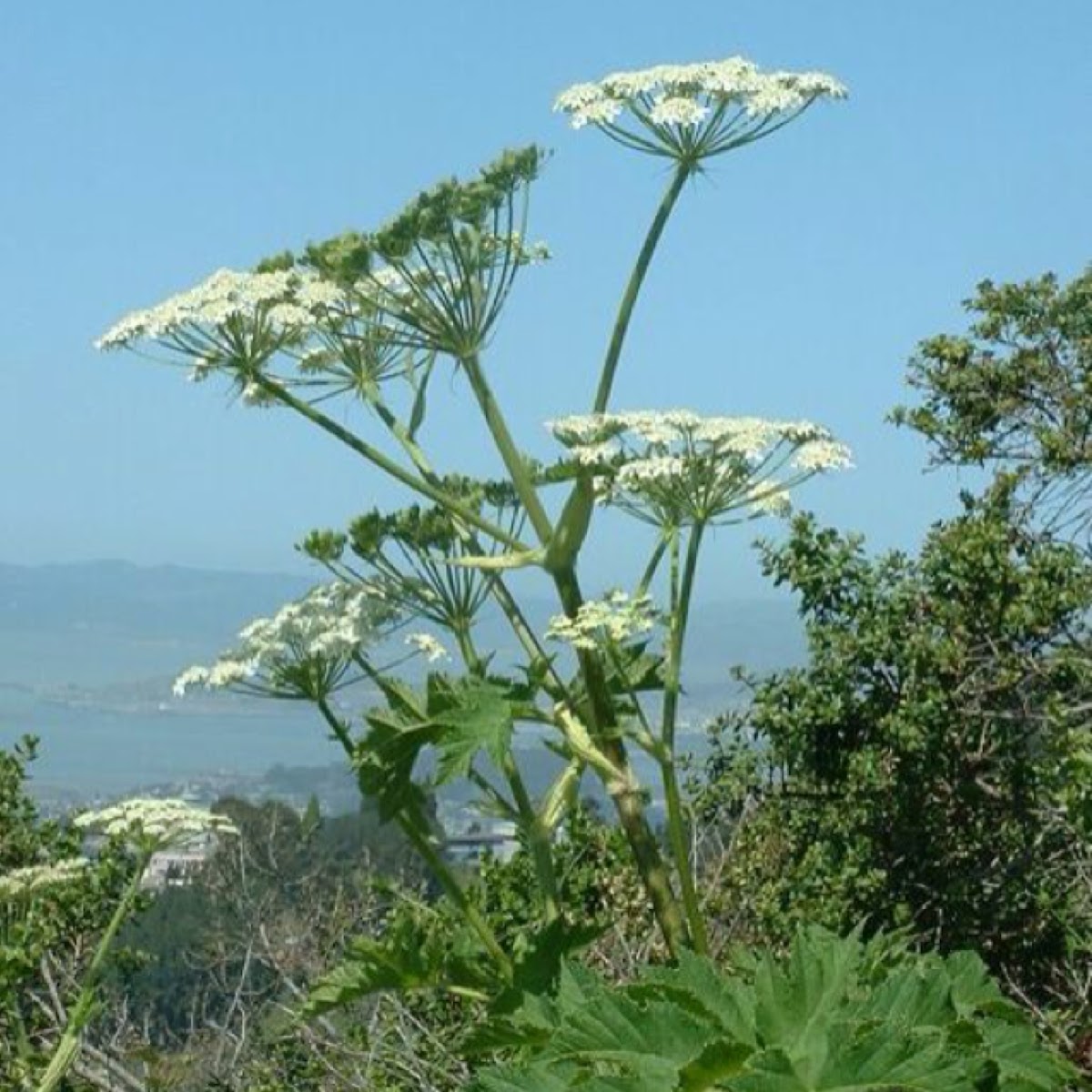
It looks like a giant version of Cow Parsnip and Queen Anne's Lace. 
Here is a webpage with a comparison chart: http://www.invadingspecies.com/invaders/plants-terrestrial/wild-parsnip/
Giant Hogweed photo by Project Noah's rayrodriguez1027
Giant Hogweed can grow over 2 metres in height. In addition to its round clusters of white flowers, it has purple spots and tiny white hairlike filaments on the stem. Before it's bloom in mid-August it is also much lower to the ground and without its distinct flowers.

While its mini-me is evocative of the delicate crochet patterns that might adorn the collarbone of her Majesty, Giant Hogweed could bedeck your skin with third degree burns, or cause blindness if even a single drop gets in your eye.

The effects are not immediate, but this plant is phototoxic and the oils will burn your skin after being exposed to light, potentially permanent effects worsening over the course of days without treatment. If you do accidentally come into contact with its toxic oils on your skin, wash the area well with soap and warm water as soon as possible and avoid sunlight for two days, and see a physician.*

If you accidentally get any on your hands, do not rub your eyes!

*Even in the age of knowledge, Google searches, and Mayoclinic, the internet doesn't replace the care of a health care professional. With Giant Hogweed effects may not be immediate but can cause permanent damage without the help of a physician. Including to tough guys (and gals) who "don't go to the doctor".
phototoxicity: (aka photoirritation) A toxic response that occurs after the exposure of skin to certain chemicals and light. It can also occur after systemic (oral or intravenous) administration.
- EURL-ECVAM (https://eurl-ecvam.jrc.ec.europa.eu/validation-regulatory-acceptance/topical-toxicity/phototoxicity)


Queen Anne's Lace is a part of the carrot family so I'm guessing giant hogweed is as well. This means that if you're trying to rid your garden of this pain-in-the-neck relative you gotta be careful not only to not touch it,  but to take out the tap root from the ground also.

Giant Hogweed is an invasive species from Asia which (surprise-surprise) was introduced by people, first to England, then to Canada including Atlantic Canada, B.C., Ontario, and Quebec. It competes with native species for resources, and the loosening of soil even after it dies or hibernates during the winter can cause soil erosion.

If you see giant hogweed in your renegading through the forst, reporting the sighting would really help the local environment and fellow outdoorsmen: http://www.eddmaps.org/ontario/ 
(To all who do this, thank you.)

Moral of the story: don't touch giant hogweed.

References*
Ontario's Invadin Species Awareness Program. (n.d.). Giant Hogweed. Retrieved February 18, 2016, from http://www.invadingspecies.com/invaders/plants-terrestrial/giant-hogweed/

 Jakuboski, Samantha. (2011, July 17). CAUTION: Giant Hogweed might be growing in your own backyard. Retrieved February 18, 2016, from http://www.nature.com/scitable/blog/green-science/caution_giant_hogweed_might_be 

EURL-ECVAM. (2012). Phototoxicity. Retrieved February 18, 2016, from https://eurl-ecvam.jrc.ec.europa.eu/validation-regulatory-acceptance/topical-toxicity/phototoxicity 

Santa Maria, Cheryl. (2015, July 22). Plant that can cause third-degree burns popping up in Canada. Retrieved February 18, 2016, from http://www.theweathernetwork.com/news/articles/plant-that-can-cause-third-degree-burns-popping-up-in-canada/54604/ 


Santa Maria, Cheryl. (2015, June 2). Bloodroot and 7 other dangerous plants: How to identify each. Retrieved February 18, 2016, from http://www.theweathernetwork.com/news/articles/toxic-plants-found-in-canada/52042/ 

Photo by Project Noah's rayrodriguez1027, from  http://www.projectnoah.org/spottings/8648105

*Apologies for the tiny font... can't seem to increase the size!